Showing posts with label Pride and Prejudice. Show all posts

Thursday, July 2, 2026

How "The Other Bennet Sister" subverts narrative convention


We've seen it countless times in romance films. The unassuming heroine who never thought of herself as a beauty gets a makeover that makes her the most stunning woman at the ball. 

What we've been conditioned to expect 

Disney has practically patented this plain to princess trope from the time that it showed the magical transformation of Cinderella's torn dress into a sparkling gown to the depiction of beauty professionals smoothing the bushy-browed, curly-haired, bespectacled Mia into the general beauty standard  ahead of dressing her in her ball gown. 

In the conventions of such films,  a heroine who does not shed her ugly duckling veneer and become the graceful swan we expect to see is unthinkable. And that is what makes The Other Bennet Sister so  daring in challenging it.  


Being the odd one out

The Other Bennet Sister is Mary's story of how she comes into her own identity and happiness. Of course, growth and change is part of that story. But the usual account of a girl's metamorphosis into a beautiful woman who only gets her due after removing her glasses, doing her hair, and wearing the right clothes is replaced by the confidence that allows Mary to be herself instead of trying to impress others and win parental approval. 

In the book, Mary keeps applying herself to books largely to try to win her father's notice and affection. That is not really shown in the adaption, which highlights more of her awareness of constantly disappointing her mother because she is not pretty enough or lively enough and has the gall to wear spectacles. In her parental home, where her sisters have paired up without her and her parents either ignore or criticize her, Mary has no one to turn to.

But that all changes when the Gardiners take her in. Her aunt does everything possible to make Mary feel at home and to build up her confidence that Mrs. Bennet's constant criticisms have undermined. And we have the requisite new wardrobe for the heroine as she makes a switch from her usual drab colors, though it's all about Mary's self-esteem rather than the usual makeover.

Though she never blossoms into beauty, Mary with her glasses and unfashionable clothes manages to attract two suitor. Tom Hayward and Will Ryder enjoy her company and conversation because she is so different from other women they've encountered and says what she really thinks.   


Clothes do not make the woman, but choosing them does

Mary's new  spring green gown
Mary's new clothes are handled very differently in the book and in the adaption. The novel gave greater weight to Mary's feelings of guilt concerning Mr. Sparrow at the Assembly ball. Associating that with a becoming cream and gold gown that she had treated herself to for the occasion make her deny herself pretty dresses afterwards. Wanting to boost her nieces confidence, Mrs. Gardiner makes the argument her that she deserves to dress in smart clothes as a reflection of how she values herself and even persuades her to allow Elizabeth -- who wishes to make amends for having played a part in Mary's embarrassment when told to stop playing piano --to pay for it. 


In contrast, in the adaption, Mary has come to the Gardiners as an interim governess, and her aunt convinces her that the position includes a dress allowance. She urges Mary to choose the fabrics she wants on her own and refuses to direct her in any way. The resulting gowns are not what would have been called "smart" at the time. The spring green gown red gown is particularly unflattering. 

Yet, as she tells Miss Baxter, it makes her feel bold. That statement proves that Mrs. Gardiner achieved her aim of bolstering her niece's confidence in herself and her ability to choose for herself, regardless of how fashionable she may appear.  

Mrs. Bennet attempts to undermine that when she offers her own commentary on the red dress and forces Mary to wear Elizabeth's gown at dinner to look more attractive to Mr. Ryder. (None of this occurs in the book.) Mary wears the blue gown that her sister wore to the ball some 2-3 years and shows her discomfort by fidgeting with the neckline. 

Elizabeth selecting her gown for the ball

This dress is the one that Elizabeth selected over a yellow one in order to disassociate herself form her mother who was wearing a similar color. Mary will echo making that choice when it comes to deciding what to wear for the hike up Scafell Pike. 


Mary chooses her blue plaid gown
Narrating her actions, Mary declares, "I had made my choice!" when she selects her own blue gown -- the plaid one she has worn many times before, though she pairs it with a fuchsia spencer. She wears the same combination when she is reunited with Tom Hayward and finally gets the romantic resolution she had hoped for.

The choice she had made was not just about her clothes but about taking control of her own life. One was marrying Tom rather than much richer Ryder. The other -- an invention of the adaption -- was to put all her learning to use as a kind of tutor/governess and pursue a career even as a statement of valuing herself beyond attaining the position of wife. That is Mary declaring her own independence from conventional standards as she pursues her own form of happiness. 

Related: 
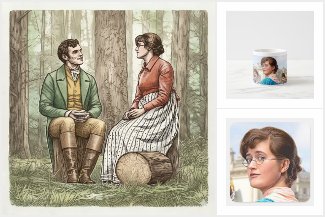
The Other Bennet Sister: Celebrating Mary Bennet

The Other Bennet Sister: Celebrating Mary Bennet
by Totally_Jane_Austen

"The Other Bennet Sister" is Closer to Jane Eyre than Jane Austen

Jane Austen and Autism

Jane Austen: Love and Money
Jane Austen at the Morgan
Love and Limerence in Jane Austen
Observations on Jane Austen's Emma
Pride, Prejudice and Persuasion: Obstacles to Happiness in Jane Austen's Novels
Three Janes, Two Governesses, and the Abolitionist Movement
The Big Bow-wow & Bit of Ivory
Jane Austen's Heroines
Jane Austen and Capability Brown
Pride and Prejudice in Job Applications
Jane Austen at 250
Many Happy Returns, Jane Austen

Tuesday, June 16, 2026

Valuing kindness above cleverness: Emma's lesson


This blanket is one of the hundreds of themed  products available at Totally_Jane_Austen 


New Yorker cartoon: "Son, if you can't say something nice, say something clever and devastating."

Facebook brought this New Yorker cartoon into my feed. I immediately thought of Jane Austen's Emma. She thought the same way the father in this cartoon does that saying something clever but devastating is an irresistible temptation, but she comes to regret the hurt she has caused. 


While the group is seated for their picnic, Frank Churchill stirs things up by declaring a demand from Miss Woodhouse: 

" 'she only demands from each of you either one thing very clever, be it prose or verse, original or repeated--or two things moderately clever--or three things very dull indeed, and she engages to laugh heartily at them all."

"Oh! very well," exclaimed Miss Bates, "then I need not be uneasy. 'Three things very dull indeed.' That will just do for me, you know. I shall be sure to say three dull things as soon as ever I open my mouth, shan't I? (looking round with the most good-humoured dependence on every body's assent)--Do not you all think I shall?"

Emma could not resist.

"Ah! ma'am, but there may be a difficulty. Pardon me--but you will be limited as to number--only three at once."

Miss Bates, deceived by the mock ceremony of her manner, did not immediately catch her meaning; but, when it burst on her, it could not anger, though a slight blush shewed that it could pain her.

"Ah!--well--to be sure. Yes, I see what she means, (turning to Mr. Knightley,) and I will try to hold my tongue. I must make myself very disagreeable, or she would not have said such a thing to an old friend."

Silver Emma quote pendant  

There is some additional dialog and a bit of narrative until Mr. Knightley is able to confront Emma alone and take her to task:

While waiting for the carriage, she found Mr. Knightley by her side. He looked around, as if to see that no one were near, and then said,

"Emma, I must once more speak to you as I have been used to do: a privilege rather endured than allowed, perhaps, but I must still use it. I cannot see you acting wrong, without a remonstrance. How could you be so unfeeling to Miss Bates? How could you be so insolent in your wit to a woman of her character, age, and situation?--Emma, I had not thought it possible."

Emma recollected, blushed, was sorry, but tried to laugh it off.

"Nay, how could I help saying what I did?--Nobody could have helped it. It was not so very bad. I dare say she did not understand me."

"I assure you she did. She felt your full meaning. She has talked of it since. I wish you could have heard how she talked of it--with what candour and generosity. I wish you could have heard her honouring your forbearance, in being able to pay her such attentions, as she was for ever receiving from yourself and your father, when her society must be so irksome."

"Oh!" cried Emma, "I know there is not a better creature in the world: but you must allow, that what is good and what is ridiculous are most unfortunately blended in her."

"They are blended," said he, "I acknowledge; and, were she prosperous, I could allow much for the occasional prevalence of the ridiculous over the good. Were she a woman of fortune, I would leave every harmless absurdity to take its chance, I would not quarrel with you for any liberties of manner. Were she your equal in situation--but, Emma, consider how far this is from being the case. She is poor; she has sunk from the comforts she was born to; and, if she live to old age, must probably sink more. Her situation should secure your compassion. It was badly done, indeed! You, whom she had known from an infant, whom she had seen grow up from a period when her notice was an honour, to have you now, in thoughtless spirits, and the pride of the moment, laugh at her, humble her--and before her niece, too--and before others, many of whom (certainly some,) would be entirely guided by your treatment of her.--This is not pleasant to you, Emma--and it is very far from pleasant to me; but I must, I will,--I will tell you truths while I can; satisfied with proving myself your friend by very faithful counsel, and trusting that you will some time or other do me greater justice than you can do now."

You can judge for yourself which adaption of the picnic at Box Hill, showed this lesson best, thanks to the compilation here:


With great status comes great responsibility 

The first line of Emma is not nearly as famous as the opening line of Pride and Prejudice, though it also archly conveys the essence of the story: "Emma Woodhouse, handsome, clever, and rich, with a comfortable home and happy disposition, seemed to unite some of the best blessings of existence; and had lived nearly twenty-one years in the world with very little to distress or vex her."

Emma seems to have all that is necessary for happiness. Out of those three attributes, she takes the most pride in her cleverness, taking her wealth for granted and lacking vanity for her appearance, as Mr. Knightley reveals in conversation with Mrs. Weston. 


Like a tragic hero, Emma's great strengths are also what lead to her undoing -- or rather some misjudgments and hurt feelings that the good-hearted Emma never intended. Austen's novels follow the conventions of Shakespeare's comedies rather than the tragedies, so everything works out fine in the end with the main characters properly paired off. 

Jane Austen Mugs
Jane Austen Mugs
by Totally_Jane_Austen
However, along the way, our heroine has to admit her faults and mistakes and learn to be better, which she does. Now that I think about it, Emma's lesson is similar to Darcy's who responded to Bingley's suggestion that he ask Elizabeth to dance with "She is tolerable; but not handsome enough to tempt me; and I am in no humour at present to give consequence to young ladies who are slighted by other men."

 Darcy came to regret that quip as much as Emma regretted what she said to Miss Bates. Like Darcy, Emma learns that kindness and consideration for the feelings of others is a greater measure of worth than attempt to manipulate others -- for their own good -- and clever remarks.  

P.S. The value of kindness is one of the Austen themes that The Other Bennet Sister gets right. Mrs. Bennet's lack of kindness to her middle daughter destroys her self-esteem. Her mother's foil is her Aunt Gardiner who is kindness herself. Mary also comments on feeling really bad about having to refuse to dance again with Mr. Sparrow whose only fault was having been kind to her and describes Tom Hayward as "the kindest man."  


Related:


Friday, May 1, 2026

Mary and Marylin: the girl in the glasses finds love

Marilyn Monroe in How to Marry a Millionaire
Mary flanked by Mr. and Mrs. Bennet in The Other Bennet Sister

Having finished reading The Other Bennet Sister after having seen the adaption,* I have a number of observations that I intend to write up. But for today, I'll keep it lighter with something that just struck me, a surprising parallel that the director may have alluded to. 

 In both the book and the adaption, Mary's glasses are made into a big deal. Her mother declares she'll never attract a man if she wears them. It's not just Mrs. Bennet's silliness. The assumption that women in glasses were less attractive persisted well over century later and is very central to the character that Marylin Monroe plays in How to Marry a Millionaire who wanders around unable to recognize people and bumping into things because she has internalized that a woman in glasses would never attract a man.


As depicted in the clip above, Marilyn's character describes herself as "blind as a bat" without glasses, which is why she holds her books upside down while pretending to read. 

I wonder if the director of The Other Bennet Sister adaption had that in mind in setting up a scene in
which Ryder holds a book upside down while pretending to read. This is not in the book, so I can't help thinking the director thought of some other films in which the upside down book proves the character is not reading. 

tom_handing_mary_out_of_a_carriage_keychain

Much more on the adaption to follow. Watch for my argument that Mary Bennet is closer to a Charlotte Bronte heroine -- with striking parallels to Jane Eyre and Lucy Snowe -- than a Jane Austen one, especially in the adaption. If you are a fan of the adaption, check out The Other Bennet Sister: Celebrating Mary Bennet  collection from Totally Jane Austen. 


*That's the order I'd recommend for others to follow to enjoy both experiences and appreciate the differences without getting bothered about deviations from the book while watching. 


Related

Many Happy Returns, Jane Austen                       


Jane Austen at 250

Jane Austen: Love and Money
Jane Austen at the Morgan
Love and Limerence in Jane Austen
Observations on Jane Austen's Emma
Pride, Prejudice and Persuasion: Obstacles to Happiness in Jane Austen's Novels
Three Janes, Two Governesses, and the Abolitionist Movement   


The Big Bow-wow & Bit of Ivory
Jane Austen's Heroines
Jane Austen and Capability Brown
Pride and Prejudice in Job Applications

Thursday, November 27, 2025

The Familiar Suitor Problem in Jane Austen's Novels


Pride and Prejudice & Sense and Sensibility Desk Organizer


"You will meet a tall, handsome stranger." That fortuneteller style promise is what many consider the epitome of romance. You meet a stranger, your eyes lock, and you take a fatal hit from Cupid's bow. Popular films and paperback novels have made that standard.

Stranger danger and fascination

In Jane Austen's novels, things work a little differently, though she does also play with the fascination people, especially romantically inclined young women, have with the attractive outsider.  If familiarity breeds contempt, than its opposite breeds fascination. As the person is not a fully known quantity like the members of the "four and twenty" families one may dine with regularly in the country, there is the introduction of a spark of intrigue in getting to learn more about them and what their lives consist of elsewhere. 

The mystery of their lives may also include a scandal or even a crime, which Catherine Moreland considers in her flights of fancy. But that hint of danger can add an extra frisson that a heroine may find attractive as we see in Marianne's response to Willoughby. Emma, on the other hand, decides to have a kind of controlled crush when Frank Churchill enters the  picture and engages in a flirtation with her to conceal the fact that he has entered into a secret engagement.

Breaking out of the friend zone

Of course, Emma ends up not marrying a stranger at all but her brother-in-law, who has been a regular in her house for years. In fact, making that transition from from the brotherly relationship one has in the friend zone to romantic interest is a challenge for both the hero and heroine of Emma, as it is for Mansfield Park. 

In the first chapter of Mansfield Park, the general rule that boys and girls who grow up in proximity to each other like brother and sister are much less likely to be attracted to each other than they would be if they meet as grownup strangers is explained by Mrs. Norris when prevailing on Sir Thomas to give a home to Fanny price: 


You are thinking of your sons—but do not you know that, of all things upon earth, 
that is the least likely to happen, brought up as they would be, always together like brothers and sisters? It is morally impossible. I never knew an instance of it. It is, in fact, the only sure way of providing against the connexion. Suppose her a pretty girl, and seen by Tom or Edmund for the first time seven years hence, and I dare say there would be mischief. The very idea of her having been suffered to grow up at a distance from us all in poverty and neglect, would be enough to make either of the dear, sweet-tempered boys in love with her. But breed her up with them from this time, and suppose her even to have the beauty of an angel, and she will never be more to either than a sister.

Mrs. Norris is mostly correct. Edmund does seem to regard Fanny as another sister but not as anything more than that. It takes some revelations about the moral failings of the strangers who bring down his actual sister to make him realize that the steadfast Fanny will serve him better than the attractive and sparkling Mary Crawford.

In Emma, Mr. Knightley never makes the mistake of falling for anyone other than Emma (at least as far as we see in the novel). However, it takes Emma's fear that it might happen -- when Harriet admits to being in love with him --  to jolt her into acknowledging how she really feels about Mr. Knightley (chapter 47). 

A mind like hers, once opening to suspicion, made rapid progress; she touched, she admitted, she acknowledged the whole truth. Why was it so much worse that Harriet should be in love with Mr. Knightley than with Frank Churchill? Why was the evil so dreadfully increased by Harriet’s having some hope of a return? It darted through her with the speed of an arrow that Mr. Knightley must marry no one but herself!

Emma tote bag

Here Cupid's arrow finally marks Emma but only many years after she first met Mr. Knightley. This is a love born of a spark maintained over time rather than a burst of flame that strikes all at once. And there's the rub because the pattern of their relationship has been set as brother and sister for so long. In fact, the dialog brings that up when they dance 10 chapters earlier in the book:

'Whom are you going to dance with?' asked Mr. Knightley.
She hesitated a moment, and then replied, 'With you, if you will ask me.'

'Will you?' said he, offering his hand.

'Indeed I will. You have shown that you can dance, and you know we are not really so much brother and sister as to make it at all improper.'
'Brother and sister! no, indeed.'


So they established that there is no fear of regarding their relationship as incestuous. But there is still the obstacle of breaking out of the friend zone, which Mr. Knightley grapples with just before he declares himself in chapter 49. Emma had just stopped Mr. Knightley from speaking because she really fears he will confess his love for Harriet. Then she realizes that he was pained by her response and lets him know she will listen:

'I stopped you ungraciously, just now, Mr. Knightley, and, I am afraid, gave you pain. But if you have any wish to speak openly to me as a friend, or to ask my opinion of any thing that you may have in contemplation -- as a friend, indeed, you may command me. I will hear whatever you like. I will tell you exactly what I think.'

'As a friend!' repeated Mr. Knightley. 'Emma, that I fear is a word -- No, I have no wish -- Stay, yes, why should I hesitate? I have gone too far already for concealment. Emma, I accept your offer, extraordinary as it may seem, I accept it, and refer myself to you as a friend. Tell me, then, have I no chance of ever succeeding?'
Watch on Totally Jane Austen

He then communicates even without words, and Emma finds herself speechless, and that leads to the most romantic line in this book, "If I loved you less, I might be able to talk about it more."

Yet they dream of Darcy

Yet women still tend to swoon far more over Darcy -- the outsider hero -- than they do over Mr. Knightley -- the familiar suitor.  There are also far more film and television adaptions of Pride and Prejudice than there are of Emma. That would indicate that  while Jane Austen was able to center a romantic novel around the more modern type of relationship that bring together two equals who marry their best friends, people still fall for the fairytale plot of the outsider coming in and rescuing the heroine to earn her love.

First line of Jane Austen's Novels Mug

Related

Jane Austen at 250

Observations on Jane Austen's Emma

Valuing Kindness Over Cleverness                                Jane Austen: Love and Money                              

Love and Limerence in Jane Austen
Jane Austen at the Morgan

Jane Austen and Autism

Jane Austen's Heroines

Pride, Prejudice and Persuasion: Obstacles to Happiness 

Three Janes, Two Governesses, and the Abolitionist Movement


Sunday, June 8, 2025

Jane Austen at 250

Jane Austen at 250
Jane Austen magnets

Jane Austen magnets
by Totally_Jane_Austen

Jane Austen was born on December 16, 1775, which means that her 250th  birthday is still a full half a year away. But why wait to celebrate?


 That's the attitude of a number of places that have are observing her birthday already in various ways. I got to see two of them in one day on a trip into Manhattan today. One was the Morgan Library & Museum exhibit, "A Lively Mind: Jane Austen at 250," which was just set on June 6 and will run until September 14, 2025. 

                    
Joan Hassal's illustrations of Jane Austen's novels published between 1957 and 1963: "Miss Crawford's Harp," "The saunter around Woodstone," "Ann[sic] Elliot and Captain Wentworth," "Captain Benedick runs for help," "Willoughby carries in Marianne," "Elinor meets Miss Steele in Kensington Gardens"

These illustrations are among the many items that enriched the Jane Austen collection at the Morgan thanks to the donation of an extensive collection amassed by Alberta and Henry Gershon Burke (who changed his last name from the more Jewish-sounding Berkowitz).  The exhibit also shows something the Burkes purchased but were pressured not to take out of England -- a lock of Jane Austen's hair that Alberta Burke gifted to the he Jane Austen Society in Chawton.

Alberta willed her her extensive collection to Goucher College and the Morgan. The former was given the books and correspondence, while the latter received Austen letters and manuscripts upon her death in 1975.  In 1979, Henry Burke, along with Joan Austen-Leigh and J. David Grey founded The Jane Austen Society of North America (JASNA).


                           Candles and other Jane Austen at 250 merch vailable at Totally_Jane_Austen

Pride and Prejudice Off-Broadway

Extending the celebration of Jane Austen, we took in the adaptation of her most popular novel in a much-cut version played by one actor and two actresses taking on multiple roles each to heighten the comedy and showcase teh adeptness of the depictions of character. In truth, the tickets were purchased before we planned the stop at the Morgan for the morning before the matinee. If you want to catch this version in NYC, you'll have to get your tickets within the month. The play's run is limited to just 5 weeks and so ends at the end of June.


This is a fun version of the novel with clever choreography and use of accessories to enable the three people on stage to represent all the Bennets, the Gardiners, Darcy, Wickham, Charlotte Lucas, Mr. Collins, Bingley, his sister, Lady Catherine de Bourgh, and Darcy's housekeeper, though it had to cut out several characters (not just the Hursts the way most productions do) and some key dialog. 


One cut particularly disappointed me: the elimination of the discussion of accomplished women. As you can see from this blog post, it's one that I consider key to the Elizabeth's character and an important life-lesson to push back when you are held to an impossible standard. 


If you want to mark the novelist's 250th birthday, there's no better way to do it than with a the Jane Austen products for sale here. I can assure you that you'll find better pricing at the Zazzle store than you would in the Morgan gift shop. I checked myself.              


                                                                                                       Puzzle from Totally_Jane_Austen


Friday, September 6, 2024

Literary LinkedIn: Pride and Prejudice Edition

Pride and Prejudice business card holder


Literary LinkedIn:  Pride and Prejudice Edition

Today I mused about how some of the different characters in Jane Austen's Pride and Prejudice would behave on LinkedIn and jotted down these takes:
  • Mr. Collins would name drop and bore everyone with his pedantic posts.
    Pride and Prejudice pillow
  • Mary would be cringe incarnate and try too hard to impress people with her accomplishments.
  • Lydia would only post videos and then shift her attention to Instagram and TikTok.
  • Miss Bingley would post only canned ideas and comments and pretend to offer helpful advice when she is really putting people down.
  • Darcy would have thousands of followers hanging on his rare posts to try to win some attention from someone with a great deal of wealth and influence. He'd ignore all the invitations to connect.

This Pride and Prejudice gif captures that fairly well.  


Then I thought why not play with generative AI to see what it would come up with for some of the characters. I tasked it with creating profiles for Mr. Darcy, Mr. Wickham, and Elizabeth Bennet. I've copied all three exactly with [my notes in red]:

# Fitzwilliam Darcy
Estate Owner and Manager | Philanthropist | Gentleman of Derbyshire

## About
Experienced estate owner and manager with a strong commitment to upholding family legacy and social responsibilities. Known for astute business acumen, principled decision-making, and a reserved yet commanding presence. Skilled in estate management, social navigation, and horseback riding.    
 ## Experience 
### Owner and Master
**Pemberley Estate, Derbyshire**
*1800 - Present*


- Oversee the management of a vast estate, including tenant farms, forests, and a grand manor house
- Implement innovative agricultural practices to increase productivity and tenant welfare
- Host social events to maintain and expand influential networks
- Manage a staff of over 50 individuals, ensuring smooth operations of the estate

### Guardian
**Georgiana Darcy**
*1803 - Present*
- Responsible for the education, social development, and financial management of my younger sister
- Collaborate with extended family members to ensure her well-being and future prospects

## Education

**Cambridge University**
*Classical Studies and Estate Management*
1795 - 1799

## Skills
- Estate Management
- Financial Planning
- Social Etiquette [well, that's debatable]
- Horseback Riding
- Dancing (Assembly Balls)  
- Letter Writing

## Volunteer Experience

### Patron
**Lambton Village School**
- Provide financial support and oversee improvements to local educational facilities

### Benefactor
**Derbyshire Hospital**
- Regular donations and involvement in expanding medical services for the local community

## Recommendations

**Charles Bingley**
"Darcy is a man of impeccable character and judgment. His friendship and counsel have been invaluable in both personal and professional matters."

**Colonel Fitzwilliam**
"As co-guardian to Georgiana Darcy, I can attest to Fitzwilliam's unwavering dedication and sound decision-making. A true gentleman in every sense."

## Interests
- Literature
- Music (particularly pianoforte performances)
- Fencing
- Landscape Design  - Fine Arts         

## Languages
- English (Native)
- French
- Latin
-Greek


-----------------------------------------------------------------------------------
# George Wickham
Military Officer | Charming Socialite | Adaptable Professional

## About
Charismatic and versatile professional with a background in military service and a talent for navigating diverse social circles. Adept at building relationships, quick to adapt to new environments, and always seeking opportunities for personal and professional advancement.

## Experience

### Lieutenant
**His Majesty's Army - Militia Regiment**
*1811 - Present*
- Serve as an officer in the militia, maintaining order and participating in local defense
- Engage with local communities, enhancing military-civilian relations
- Demonstrate leadership and tactical skills during training exercises

### Personal Assistant (former)
**Pemberley Estate, Derbyshire**
*1808 - 1810*
- Assisted in various estate management tasks
- Cultivated relationships with key stakeholders and local gentry
- Gained valuable insights into high society operations and estate management

### Aspiring Clergyman (abandoned)  [Wouldn't he say Ex-Church of England just like people like to say Ex-Google? ] 

**Church of England**
*1805 - 1808*
- Pursued theological studies with the intention of taking orders
- Developed public speaking and community engagement skills

## Education

**Cambridge University**
*Classical Studies*
1801 - 1805

## Skills
- Public Relations
- Networking
- Adaptability
- Persuasive Communication
- Horseback Riding
- Fencing
[-Seducing young women should be included.}

## Volunteer Experience

### Community Liaison
**Various Local Assemblies**
- Facilitate connections between military personnel and local residents
- Organize social events to boost morale and community spirit

## Recommendations

**Colonel Forster**
"Wickham has proven to be a charming addition to our regiment. His ability to lift spirits and engage with the local community is commendable."

**Mrs. Bennet**
"Such a delightful young man! Mr. Wickham's presence always brightens any social gathering. A true gentleman with impeccable manners."

## Interests
- Literature and Poetry
- Ballroom Dancing
- Card Games
- Theatre and Performances
- Travel and Adventure
-Extorting Money

## Languages
- English (Native)
- French (Conversational).


---------------------------------------------
So we have the hero and anti-hero of the novel. I then asked for the heroine, and found it quite interesting that Claude put in this little introductory note before generating it: 

Certainly, I'd be happy to create a LinkedIn profile for Elizabeth Bennet from "Pride and Prejudice." This will be an interesting exercise in translating her 19th-century accomplishments and characteristics into a modern professional format.

# Elizabeth Bennet
Accomplished Gentlewoman | Avid Reader | Critical Thinker

## About
Intelligent and vivacious young woman with a keen eye for social dynamics and human nature. Known for quick wit, love of learning, and ability to challenge societal norms. Excels in conversation, literary analysis, and navigating complex social situations with grace and humor.

## Experience

### Estate Manager in Training [Honestly, this description is much more of a match for Anne in Persuasion than for Elizabeth who doesn't take that much interest in the estate or  in blanacing the budget] 
**Longbourn Estate, Hertfordshire**
*1811 - Present*
- Assist in the management of family estate, including household operations and tenant relations
- Develop skills in budgeting, resource allocation, and social event planning
- Advocate for more efficient and equitable estate practices

### Tutor and Mentor
**Bennet Family**
*1808 - Present*
- Provide guidance and educational support to younger siblings [with dubious success, as revealed by Lydia's behavior] 
- Foster a love for literature and critical thinking among family members
- Encourage the pursuit of personal growth and intellectual development [mostly in her conversations with her father, with the rest of the family, not so much]

## Education

**Home Education**
*Comprehensive studies in Literature, History, Music, and Modern Languages*
1800 - Present

## Skills
- Critical Thinking
- Public Speaking
- Literary Analysis
- Piano Performance
- French Language
- Walking and Nature Observation
- Social Etiquette
- Needlework

## Volunteer Experience

### Community Engagement Coordinator
**Meryton Assembly Halls**
- Organize and participate in local charitable events
- Foster community spirit through social gatherings and dances

### Literacy Advocate [This is rather a bit of a stretch. She doesn't come across as particularly concerned about the tenants of Longbourn, though she would probably have to take on more such responsibilities as the mistress of Pemberley.]
**Longbourn Village**
- Promote reading and education among tenants' children
- Provide informal tutoring in reading and writing

## Recommendations

**Charlotte Lucas**
"Elizabeth's quick wit and insightful nature make her an invaluable friend and a formidable conversationalist. Her ability to see beyond social pretenses is truly remarkable."

**Jane Bennet**
"My sister Elizabeth possesses a rare combination of intelligence, empathy, and determination. Her support and guidance have been instrumental in my own personal growth."

## Interests
- Classic and Contemporary Literature
- Philosophical Debates
- Nature Walks and Sketching
- Musical Performances
- Travel and Exploration of New Cultures                         

## Languages
- English (Native)
- French (Fluent)
- Italian (Basic)

-------------------------------------------------------------

It seems Claude is much more comfortable writing up the profiles of men whose lives more closely match the pattern of people today in terms of formal education and professional roles than with describing women whose more restricted activities do not lend themselves as well to this form of profile. 


Related


Pride and Prejudice in Job Applications

Jane Austen: Love and Money
Love and Limerence in Jane Austen
Jane Austen at the Morgan
Three Janes, Two Governesses,
Observations on Jane Austen's Emma
Jane Austen and Autism
Jane Austen's Heroines
Pride, Prejudice and Persuasion: Obstacles to Happiness in Jane Austen's Novels
Pride and Prejudice in Job Applications
The Big Bow-wow & Bit of Ivory
Jane Austen and Capability Brown

I appreciate your attention and generosity. Tips accepted via Zelle.

If you enjoyed this content, you can support my work with a tip or purchase from my Zazzle store.

If you enjoyed this content, you can support my work with a tip or purchase from my Zazzle store.
Find great gifts and party accessories for literature lovers in all price points.