Showing posts with label Holocaust. Show all posts

Tuesday, March 8, 2022

On Valor and Virtue


If you're not familiar with Chiune Sugihara, the Japanese  diplomat posted in Lithuania during World War II who saved 6,000 lives by issuing visas to Jews, you can learn about him and find references to look up here: ushmm.org/collections/bibliography/chiune-sugihara.

For the sake of this post, I'd just like to quote what he said about his own heroism in reply to the question the author of Pepper, Silk & Ivory: Amazing Stories about Jews and the Far East (p. 189) asked about it:
"Everyone in life as an opportunity to do a good deed. Do it and leave it alone. Don't write about it or publicize it; don't make money from it. Just do what's right because it's right."


The book also recounts that he had no way of knowing at the time if the visas would accomplish his aim of saving lives. Sugihara's son Hiroki reported that when his father found out how successful his rescue efforts proved, he said, "This is the happiest day of my life."                                                                   

Friday, July 17, 2020

The Bambi Backstory

While reading Nathalia's Holt's The Queens of AnimationThe Untold Story of the Women Who Transformed the World of Disney and Made Cinematic History I learned a number of surprising things about the development of Disney's films - both the most iconic and the ones that do not survive on video because of their overt racism (ike Songs of the South) or the ones that have been censored for the same reason (like Fantasia).

But for me the most surprising  revelation of the book was about a Disney movie I've never even seen. Before Bambi made it to film, it was a novel written by Felix Salten and called Bambi: A Life in the Woods.

The author was born in Budapest in 1869, though his family moved when he was a month old to Vienna. The motive, as Holt explains (96) was to gain greater opportunity in a city that had begun granting some rights to Jewish resident in 1867.

Salten had a strong sense of Jewish identity that found expression in his passion for Zionism. Like the fictional Mordechai in George Eliot's Daniel Deronda, he was a big advocate for a Jewish homeland.

Salten's novel first saw print in the form of newspaper serialization in Vienna in 1923.
Just over a decade later, the copies of the book were thrown on Nazi bonfires.  Holt  explains (p. 26), "The book was banned not only because of the author's Jewish heritage but also for its metaphors about anti-Semitism. "

While this is a revelation for people familiar with the deer as depicted by Disney animation, back in the early 20th Century, people understood the allegory. Even the description of the butterflies touches on the experience of people who cannot find any permanent home "'always searching further and further because all the good places have already been taken,'" Holt quotes (26).

 Bambi was a means of exploring the themes related to Jewish identity and surivial.  The deer in this story are not carefree creatures but burdened by the persecution they endure from hunters and who have to consider if assimilation is the path to take to survive.

 While some animals adopt "If you can't lick 'em, join 'em" to try to survive with hunters, that strategy fails them, as illustrated by a character who believes wearing a halter will protect him who ends up shot by a hunter. Likewise, the dogs in the novel are described by Bambi's father thus: "'They pass their lives in fear, they hate [Man] and themselves and yet die for His sake'" (quoted in Holt 96).
Though Holt comments on how very appropriate that was for the time at which Bambi is made, it really is a perennial theme for people who have repeatedly been displaced and threatened.

The book is interesting also for the glimpses into working as a woman in what was very much a man's field, and the bad old days of sexism, racism, and persecution of Asians under Roosevelt. If aviation is also of interest, you may enjoy her tangents about the animators who also aspired to fly and their achievements in the air as well as on film.

Monday, November 25, 2013

It's a meaningful life

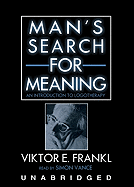
Yesterday I finally read a book that's been on my list, so to speak, for a while: Viktor Frankl's Man's Search for Meaning.It only took a few hours, as it is a very short and compelling (though not light) read.If you look up the book or Frankl online, you will usually a see one long quote from the book, it's one about how much he thought about his wife.
That brought thoughts of my own wife to mind. And as we stumbled on for miles, slipping on icy spots, supporting each other time and again, dragging one another up and onward, nothing was said, but we both knew: each of us was thinking of his wife. Occasionally I looked at the sky, where the stars were fading and the pink light of the morning was beginning to spread behind a dark bank of clouds. But my mind clung to my wife's image, imagining it with an uncanny acuteness. I heard her answering me, saw her smile, her frank and encouraging look. Real or not, her look was then more luminous than the sun which was beginning to rise.
A thought transfixed me: for the first time in my life I saw the truth as it is set into song by so many poets, proclaimed as the final wisdom by so many thinkers. The truth – that love is the ultimate and the highest goal to which Man can aspire. Then I grasped the meaning of the greatest secret that human poetry and human thought and belief have to impart: The salvation of Man is through love and in love. I understood how a man who has nothing left in this world still may know bliss, be it only for a brief moment, in the contemplation of his beloved. In a position of utter desolation, when Man cannot express himself in positive action, when his only achievement may consist in enduring his sufferings in the right way – an honorable way – in such a position Man can, through loving contemplation of the image he carries of his beloved, achieve fulfillment. For the first time in my life I was able to understand the meaning of the words, "The angels are lost in perpetual contemplation of an infinite glory. 
He also directs a friend to deliver this message:  ‘Listen, Otto, if I don’t get back home to my wife, and if you should see her again, tell her that I talked of her daily, hourly. You remember. Secondly, I have loved her more than anyone. Thirdly, the short time I have been married to her outweighs everything, even all we have been through here.’ ”  As it happens, the message never could get delivered. The NYT obituary reveals that his wife, who was pregnant, had already been killed, a fact that he only alludes to in the book.
 I didn't even know if she were still alive. I knew only one thing -- which I have learned well by now. Love goes very far beyond the physical person of the beloved.It finds its deepest meaning in his spiritual being, his inner self. Whether of not he is actually present, whether or not he is still alive at all ceases somehow to be of importance....
Had I known that my wife was dead, I think that I would still have given myself, undisturbed by that knowledge, to the contemplation of her image, and that my mental conversation with her would have been just as vivid and just as satisfying. [then he quotes from Song of Songs] " Set me like a seal upon thy heart, love is as strong as death." 
While this sounds very Romantic, Frankl really sees it as a way to keep going rather than clinging to the past. He married again (a Catholic this time) after the war.  

Finding meaning for life in love in this way is very Existential. In a nutshell, Frankl's philosophy and its application to psychology as logotherapy is Friedrich Nietzsche's assertion, “Those who have a why to live, can bear with almost any how.”

That is why he says that some people who had less physical strength survived the concentration camps than those with more -- because they had an inner life to draw on, something to make their suffering meaningful. He does admit, though, that these are not the majority of people, though he posits that any can pull it off attests to human capacity for spiritual (or, if you prefer, mental) dominance over physical conditions. 

However, one brief passage in the book that really struck me was his considering waking up a inmate who was suffering from a nightmare only to think better of it because no nightmare could be worse than their reality in the concentration camp. There is a type of suffering that can become overwhelming, even to the strong. And I do wonder why, as he demonstrates some familiarity with Scriptures, he didn't look at the story of Job. Perhaps he would say that the lesson there was also about finding meaning in suffering. Job could not take the pain when he could see no reason for it.


All this is pretty heavy stuff, but some lessons that he imparts have counterparts in much lighter contexts. Many years before Frankl published his pieces on logotherapy LM Montgomery wrote of one of his solutions. In one of the sequels to Anne of Green Gables (I believe it was Anne of the Island), Anne has a roommate of a rather flighty disposition. 

She has difficulty making up her mind until the pastor that she ends up marrying advises her herself at 80 and consider what she would you have been glad she had done.  Frankl offers almost the exact same thing in his therapy for a woman who was suicidal. He has her visual looking back on her life at 80. That's when she realizes that, despite her present despair, her life is rich in meaning. 

Related: Making life meaningful even when facing death


Related" Making Life Meaningful Even When Facing Death

I appreciate your attention and generosity. Tips accepted via Zelle.

If you enjoyed this content, you can support my work with a tip or purchase from my Zazzle store.

If you enjoyed this content, you can support my work with a tip or purchase from my Zazzle store.
Find great gifts and party accessories for literature lovers in all price points.