It is a truth universally acknowledged that the Austenian literary paradigm demands that the heroine get her man.
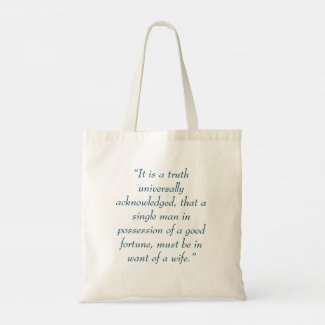 |
| Pride and Prejudice Tote Bag by Totally_Jane_Austen |
Bronte's bestseller
"Reader, I married him," is among the most memorable lines in English literature. It's also one of the reasons why a lot more people reads Charlotte Bronte's Jane Eyre -- a story that has successfully been translated to the screen time and time again -- than her more mature novel, Villette. Ever see an adaptation of Villette? I haven't either.
Granted, Jane Eyre is a more likable heroine than Lucy Snowe. But the difference in endings and romantic resolutions are a key difference. While Jane does get to decline a proposal, she also does get to marry her man on her own terms. In contrast, in Villette, the heroine only can picture her own reunion with her beloved professor that will not be realized.
I do recall one professor in graduate school considering that a triumph because she thought that actually having to live with M. Paul Emanuel would prove irritating. However, the tone is not one of "I dodged a bullet there," so much as "I'll have to make it on my own now. I will endure despite the loneliness." That's not really what readers tend to expect in novels built on the framework of classic comedies.
Rooted in Shakespeare
If you've ever taken a Shakespeare class, you should already know that the definitive trait of comedy is not humor but a happy ending in which all the problems and threats are smoothed away, and society can function smoothly. As it says near the end of A Midsummer Night's Dream: "Jack shall have Jill/ Nought shall go ill."
Shakespeare always included a marriage or two on the horizon to point out that social harmony is indeed restored. In that way, it echoes the stereotypical fairy tale structure that ends with the prince and the princess marrying and assurance that they "lived happily ever after."
While there are novels that follow the plot lines of classical tragedy, as we see in the works of Thomas Hardy, as well as novels that declare themselves free of heroes, as is the case of Vanity Fair, the novels that fit the chick lit mold set by Jane Austen work out very much like Shakespeare's comedies. Stability is restored at the end, and the heroine is happily married.
The expectation was built up by the paradigm of novel forms that supplanted many others: the books written by Jane Austen. That was the model of women's writing pushed on Bronte. Though she rebelled in her own way by insisting on an vividly outspoken though plain-looking governess rather than a lady who never had to earn her living as her heroine, she did, ultimately conform to the marriage plot in Jane Eyre.
Bronte's other two complete novels, The Professor and Shirley do have marriages, though they are rarely included in English literature courses. (Loads more than you probably wish to know about the complete Charlotte Bronte oeuvre in (En)gendering Romanticism: A Study of Charlotte Bronte's Novels ) By the time she got to Villette, she e felt confident enough to deviate from the formula, though the result is that a very fine novel gets far less name recognition and rates no box office appeal.
Little Women as Chick Lit
Now let's cross the Atlantic and jump ahead a bit in history to consider Louisa May Alcott's masterpiece, Little Women. My alternative title for this blog was "Why Louisa May Alcott's Heroine Could Not Remain a Literary Spinster."
As the latest adaption of the classic beloved by generations of girls sought to highlight in its framing of the ending, the author did not intend to marry Jo off at all. (Read about that here: https://www.historyextra.com/period/victorian/history-little-women-louisa-may-alcott-writer-who-when-how-much-inspired-by-life/) Despite reader pressure, she declared, “I won’t marry Jo to Laurie to please anyone.”
 |
| https://upload.wikimedia.org/wikipedia/commons /thumb/9/9c/Little_Women_-_frontispiece.png/ |
But her idea to leave her heroine as a "literary spinster" would not go over, and so she took perverse pleasure in marrying Jo off to “a funny match," the much older, somewhat stodgy Professor Friedrich Bhaer. (Though I haven't done real research into Alcott's reading, I find it hard to believe that the German Bhaer was not somewhat inspired by the professor figure in Bronte's works. )
Whatever you feel about the Laurie ship veering off course from Jo to Amy, which does come off as contrived, indeed, the potential resolution of leaving Jo as the solitary artist figure scribbling alone would have disappointed readers, likely made the book sell fewer copies, and certainly resulted in far fewer film adaptations.
Think of another heroine beloved by generations of young girls, Anne Shirley. While readers enjoy her continued adventures as a young single women, working as a teacher and earning her university degree, the expectation that she will end up with Gilbert Blythe is built in from the moment he says, "Carrots!' It can be delayed through several books, but it is, ultimately, inescapable for the books and the screen adaptions that have multiplied in recent years.
Exceptions do not disprove the general rule
That is not to say that no novels without marriage resolutions are adapted. Certainly some are, though not nearly with the same frequency as those that do feature the conventional happy ending.
Having the heroine remain single is not nearly as satisfying in terms of mass appeal.
The reader now may be bristling at the thought that we retain the same kind of conventional expectations even in modern times. Aren't we now enlightened enough to appreciate a story that does not end like a child's fairy tale? Yes, certainly, some of us are. But when success is measured in terms of pleasing the most possible people, you do need to stick to certain conventions.
Austen fans in a tizzy
This becomes clear in the reactions to the ending of the Sanditon series. If you look on IMDB, you'll see that while most episodes rate about an 8, some even close to 9. But the final episode only rates a 6.9 and includes some individual ratings as low as one from viewers who were bitterly disappointed in the ending. Here's a typical one star review:
If you are going to finish a Jane Austen story, please give it a Jane Austen ending! I have really enjoyed this series but the ending completely ruined it all. All I can think is they wanted to leave it open for series two? But why wreck a whole series in the hope to hook people to a second. The ending this story deserved would have made me watch a second, but this? Doubtful!The argument is if you're going to bank on the Austen name to lure us in, you better deliver on the promised happy ending we've grown to expect from the completed six novels. Obviously, the producers of the series intended to not end the first season with the happily ever after for the heroine because there had been hopes of a second series, but that is not enough to assuage the outrage born of expectations unmet.
The pull of the marriage plot in a Jane Austen work is simply too strong to be disregarded. Working against type here would leave your readership or audience is disconcerting as they feel cheated out of the social resolution established in for the genre of comedy and the novel about women.
Related:
Love and Limerence in Jane Austen
Three Janes, Two Governesses, and the Abolitionist Movement
Some observations on Jane Austen's Emma
Jane Austen and Autism
Jane Austen's Heroines
Pride and Prejudice in Job Applications
Pride, Prejudice and Persuasion: Obstacles to Happiness in Jane Austen's Novels
The Big Bow-wow & Bit of Ivory
Jane Austen and Capability Brown
Pride and Prejudice in Job Applications
Some observations on Jane Austen's Emma
Jane Austen and Autism
Jane Austen's Heroines
Pride and Prejudice in Job Applications
Pride, Prejudice and Persuasion: Obstacles to Happiness in Jane Austen's Novels
The Big Bow-wow & Bit of Ivory
Jane Austen and Capability Brown
Pride and Prejudice in Job Applications


