Showing posts with label representation. Show all posts

Sunday, May 23, 2021

The Tech Gender Gap: 10 Facts


Minding the Gender Gap: 10 Facts about Women in Tech

The original version of this article posted on May 3, 2019 and was assigned to the URL that now links to the updated version I wrote in 2021. https://www.techopedia.com/minding-the-gender-gap-10-facts-about-women-in-tech/2/33715 

Assessing the state of women in tech does present a kind of half-full – or more precisely quarter-full – glass perspective. There is definitely still a marked gap in terms of representation in the field and even pay. However, there are also signs of movement in the right direction. So while we do mind the gap, we should also look at what works to narrow it down.

1. The quarter-full glass on the job level

According to the women in tech statistics assembled by Honeypot, the U.S. is ranked second worldwide for female opportunity in tech. But even in this country, women make up less than a quarter (24.61%) of the U.S. tech sector while they make up 46.76% of the workforce across all industries.

That figure is better than the representation women achieved in HackerRank’s survey of over 14,000 professional software developers, which included fewer than 2,000 women. As the notes on the Kaggle data set pointed out, that amounted to just a 16.5% to 83.4% (female-to-male) ratio. But around a quarter is likelier in light of the numbers of engineers in actual companies updated regularly on a spreadsheet in Tracy Chou’s Women in Tech list. Though the numbers vary widely, the average representation for women software engineers at the companies listed appears to fit that percentage figure that comes close to a quarter.

Further corroboration comes from the Wall Street Journal, which cites figures from AnitaB.org, which surveyed over 628,000 people in technology and found women at 24% in 2018, of them a figure that represents 1.09% growth over the previous year.

2. The quarter-full glass on the education level

About a quarter of STEM graduates are female, according to Honeypot, 24.24% to be precise. HackerRank emphasizes the positive here, saying, “young women today are 33 percent more likely to study computer science compared with women born before 1983.” It also says that they are on the right track in studying “the exact same languages that are most in-demand for roles across front-end, back-end, and full-stack, according to our 2018 Developer Skills Report.” So there is progress, and it does make sense to have about the same percentage for graduates as one finds in the workforce. But then there’s the next fact.

3. Women still come up short on the pay level

Women who have positions in tech are not achieving pay parity. According to the Honeypot figures, men in tech in the U.S. are earning $98,265, while women are earning an average of $86,608, indicating a pay gap of 11.86%.

4. Where the glass drops below the quarter rate: in more advanced positions

Even the optimistically worded HackerRank admits “there’s one fact that’s hard to ignore: Women are by far more likely to be in junior positions than men.” They found that one-fifth of women remain in junior positions even when they’re over 35, which translates into their being “3.5x more likely to be in junior positions than men.”

5. Women tend to leave 10 years in

While women may hold close to a quarter of tech positions, the percentage drops for higher level jobs in tech. “Leave rates for women in science, engineering, and technology (SET) peak about 10 years into their careers,” according to Catalyst. This drop-off is very significant, not just for the lack of representation of women at high levels, but because it translates into fewer women in tech positions that would have the power to hire.

6. The glass is only 1/10 full at the hiring manager level

That is borne out by the additional insight on HackerRank’s Kaggle comments. There are far fewer female hiring managers than male ones – just 10.3% among those surveyed. That doesn’t bode well for new entrants into the field connecting with mentors and sponsors to stay on track to advance their own tech careers and avoid the drop-off.

7. Women CIOs are still scarce but have increased

Though there is still only a one in five chance that you’d find a woman in the position of CIO at a Fortune 500 company, that still marks some improvement over the 16% share for women in 2017, according to Boardroom Insiders and represents the best levels it has seen in its tracking over the last ten years.

8. How women CIOs get there

Education appears to be a major factor in women’s advance to the CIO position. Boardroom Insiders found that 40% have MBAs, which is up from 34% in 2017. A somewhat larger number – 51% – have at least one advanced degree. The graduate program route is more popular than starting at the bottom. Just 11% said that’s the way they got to their CIO position, a significant drop from the 19% in that category last year.

9. Progress on the entrepreneur level

In 2018, over 40% of new entrepreneurs in the U.S. were women, according to the 2017/18 Global Entrepreneurship Monitor (GEM) report. Sarah Wefald, technical product manager at Laserfiche takes this as a positive sign because “having women tech leaders can have an effect on the entire workforce.” She notes that her own company “was founded by a woman in the 1980s,” when it was considered remarkable, and now women make up nearly half of Laserfiche’s employees.

10. It pays to support female founders

Women at the helm doesn’t only translate into better opportunities for women, but for investors as well. First Round reports a 63% better return for “companies with a female founder” than for those “with all-male founding teams.” As Monica Eaton-Cardone comments, “Thus, betting on diversity is a smart investment. Despite that, we still have incredible disparity in terms of who gets funded, and I believe that women being underrepresented in decision-making roles is a major reason why.” This “creates a kind of self-fulfilling prophecy: Women can’t get access to VC funding, and thus, have a hard time refuting the line of thought that prevents them from getting access.” (Crypto is helping to create gender equality in business. Learn more in How Crypto Can Help Women Gain More Equal Footing in Business Leadership.)

Conclusion

While the glass is currently about a quarter full overall, we have to note where there is movement and what has yet to be done. It is important to open more possibilities for women to not only enter the field of tech but to stay on, advance and lead. That assures not just a more equitable future, but a more profitable one, as well.

Sunday, June 3, 2018

Feminine feet: a study in contrasts

Two current exhibits at the New York Historical Society offer a study in contrasts in representing the feminine ideal as represented by their feet. In one feet are said to become worthy of their own cameras on the red carpet when they are encased in shoes like the diamond encrusted sandals pictured below:

$1,090,000 dollar sandals  decorated with 464  Kwiat diamonds.  In 2002, these diamond shoes were worn by Oscar nominee Laura Harring. Supposedly, that's what started the trend of a cameras placed to capture footwear at the Oscars. A replica of these shoes are  the first object in the current exhibit, Walk This Way: Footwear from the Stuart Weitzman Collection of Historic Shoes.

A number of problems I had with the exhibit:
1. The shoes are arranged in a particularly logical order like a chronological one or even an arrangement of shoes for work and shoes for parties and shoes for occasions. The arrangement keeps jumping around in history. There is some attempt to tie some shoes to historical events-- from changes in hemlines and dance styles to women's role in producing shoes, but there is no particularly cohesive story line.
2. The exhibit is about 90%  decorative but impractical high heels.  You can hear Weitzman talking about the eternal quality of high heels in the exhibit's audio tour. He claims they will always be around because nothing makes legs look better. He seems oblivious to the fact that not all women are willing to sacrifice their comfort and stability to heighten their decorative appeal. He also seems to be unaware of the trend since the 80s (as far as I recall from my own exposure to shoe brands and ads) has been to offer women shoe options that actually allow them to walk beyond a red carpet. Even before that, there were always women whose first priority for shoes had to be something durable.

This brings me to the point of contrast on what we idealize in women I noticed when viewing Norman Rockwell's famous "Rosie the Riveter" painting in full in the Rockwell, Roosevelt & the Four Freedoms exhibit.  One freedom that is not included in the four is the freedom of movement for women constrained by feminine fashion. Here we see a heroine for the World War II period named Rosie who is dressed in practical clothes with practical shoes (no high heels on a job that requires you to be stable on your feet). In fact, her comfortable loafers are poised over a copy of Mein Kampf. It is not delicate footwear that will defeat tyranny and hate but sensible shoes worn by a woman who is willing to get her face dirty and get the job done. 

Rosie is, in fact, shown as angel with a dirty face. As the description of the painting points out, her protective mask is pushed up in a position to assume the shape of a halo.  She is depicted as the strong female force of good that will stamp of evil. 

The exhibit also shows the usual poster associated with Rosie the Riveter, which is not a full length picture and includes the slogan "We can do it!" This version, which you can see in the still from the video below, was not created by Normal Rockwell but the Pittsburgh artist J. Howard Miller. Why more than one Rosie? The idea of Rosie the Riveter was depicted in song. You can hear it on this video. 


If you'd like to see a video that offers more information on the Four Freedoms and Rockwell's depiction of them, you can click on this video.

Wednesday, June 13, 2012

Any other plain Janes?

Among Charlotte Bronte's claim to fame is her success in going against the grain of beautiful heroines. While her juvenilia did feature the standard beautiful type, in her two most popular novels, Jane Eyre and Villette, (The Professor also features a small and plain heroine, though she is not the central character of the book and is not as well delineated as her later heroines) her heroines fascinate based on what's inside rather than what's outside. They proved her capable of what she promised her sisters, " I will show you a heroine as plain and as small as myself, who shall be as interesting as any of yours." 


I was thinking about this now because it seems to me that literature (and films or television adaptions) are still peopled by beautiful heroines. If the girl was born plain, all she has to do is get the right dress, hair style, and makeup (perhaps also eyebrow shaping) to appear as the beauty she was meant to be.  Typically the one who appears mousy just sheds her glasses, shakes out her hair and gets the right dress to get noticed. 


In contrast, Jane Eyre resists that convention of the ugly duckling blossoming into a swan. When Rochester attempts to buy her gorgeous gowns and jewels, she does not feel the elation that girls typically exhibit when donning such lovely things. Instead, she feels her cheeks burn.  


There is also an interesting take on dressing up in  for Lucy Snowe, the heroine of Villette.  Normally, she dresses in shadowy colors and stays in the background, but on one night she dares to wear pink and spots herself in the mirror as if she had come upon a stranger. But the dress (italicized for the central role it plays in so many Cinderella type stories) does not win her the attention of the man she adores who is smitten by a superficial beauty until he turns his attention to another whose beauty is less showy but is still distinguished from the plainness of the heroine. 


I'm wondering: do any other novel achieve a heroine who does manage to captivate someone in a romantic sense even though she remains  plain? 


Wednesday, May 30, 2012

Perspectives on Introversion (this is a long post)


Within the space of a number of weeks, I read

Order these here 

 three books on introverts. I started with most recent and most publicized within that category: Susan Cain’s Quiet: The Power of Introverts in a World That Can't StopTalking(2012) 

Unlike the authors of the other two books, Susan Cain is not a psychologist. She actually started out as a Wall Street lawyer. Having recognized her own ability to negotiate based on introverted traits and became a consultant and writer. Her book reflects some careful research and interviews with some insight based on her own experience.  


The pieces of the book may have functioned as separate articles. She talks about quiet strength in heroic figures like Gandhi and Rosa Parks – who partnered with the more extroverted Martin Luther King, Jr.  She runs through the problem for introverts at school who are utterly silenced by the dynamics set into play by group divisions and work places that  that torture introverts with open plans. She also looks at the contrast between Asian (quiet, introverted) culture and American (louder, extroverted) culture and how those caught between two worlds cope.  

While Cain is generally very positive about introvert traits, the book does include sections on faking it as an extrovert, which she calls “self-monitoring.”  It becomes necessary for any introvert whose life’s passion includes the necessity of interacting with groups of people, whether it is a professor who must deliver lectures or an author who must promote her book.

The second book I read on the topic was The Introvert Advantage: How to Thrive in an Extrovert World by Marti Olsen Laney (2002).  I found this one seriously annoying at times. The fact that the author insists on referring to introverts as “innies” made me want to take Dorothy Parker’s advice about a certain novel and throw it with great force. However, I refrained from doing so because it was a library book and I was resolved to follow through on reading, for persistence is one of the great introvert traits.

Laney’s book is just loaded with advice, much of which is not particular to introverts – like pack
sunscreen, drink water (add some lemon juice to pick yourself up) and dress in layers to assure comfort. She justifies the inclusion of such by saying that introverts tend to have sensitive skin and also may be more sensitive to temperature changes with a tendency to be cold. Well, I do slather on the sunscreen but not because of any introvert traits. Such practical but somewhat irrelevant advice is a minor annoyance, as far as this book goes.


 What is more problematic is the way she constructs an introvert. She stresses that introverts are set in a “throttle-down” mode which makes it take longer for them to process information and more stimulant-averse. That may be true, but really I have not found that being an introvert makes me any slower than other people. In fact, I move pretty quickly and efficiently. 


 The thing that most bothers me about Laney is that her book title is completely misleading.  The way introverts come off, poor, delicate, slow creatures who are easily overwhelmed, they really have no advantage. In fact, in order to survive they simply must learn how to act and talk like an extrovert. 


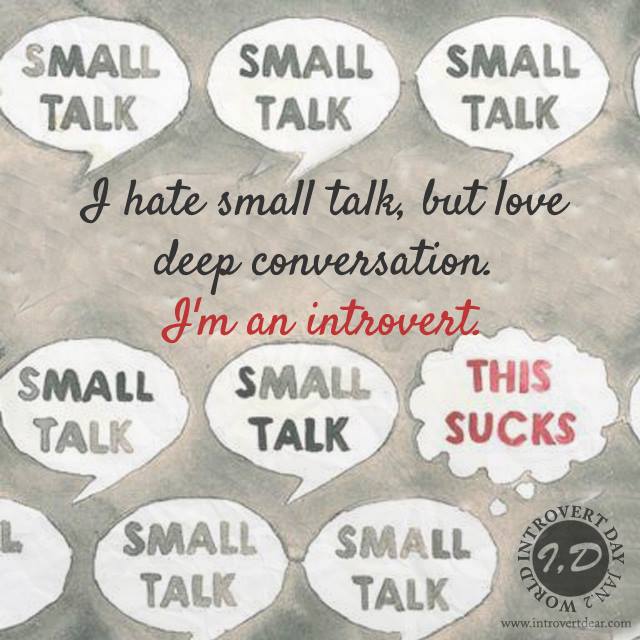
 The lowest point for me in the book is when she offers suggestions to make small talk that include gems like “Isn’t the food delicious?” and “Isn’t this a lovely home?” Yup, that’s just what introverts despise – empty conversation just to fill in the silence.  If you have to resort to such stratagems, you may want to consider Lincoln’s observation, “Better to remain silent and be thought a fool than to speak out and remove all doubt.”  


In contrast to Laney's approach, Laurie Helgoe’s book, IntrovertPower: Why Your Inner Life Is Your Hidden Strength (Sourcebooks 2008)  is the ultimate introvert manifesto. It pretty much say, “We make up at least half the world’s population; we have the right to be ourselves and not conform to any other standard.” She spends quite a bit of time debunking the perception that introverts make up only 1/3 of the world and so are overwhelmed by the majority made up of extroverts. She points to flaws in statistics and identification to make the case for over 50% of people qualifying as introverts.  Cain does touch on the perception of numbers but does not make the larger number central to her approach.


 I admit I found this book a lot more fun to read than Laney’s. It also flowed rather more organically than Cain’s. She does touch on Japanese culture, as Cain did, but in a much more brief and personalized way. The focus of the book nearly always comes back to Helgoe’s assertion of being an unapologetic introvert.  That is someone who does not buy into the argument that she is missing out on the fun that extrovert have: “The Socially Accessible introvert looks like an extrovert on the outside and sees extroversion as a bar that he or she can never quite reach. These individuals are often very successful in social arenas, but fault themselves for not having fun.”  That leads to feelings of “alienation from self” which can result in depression (p 27).  


Her positive spin on introvert traits really resonated with me, like the definition on p. 7: 

being an introvert does not mean you’re antisocial, asocial, or socially inept. It does mean that you are oriented to ideas…. It means that you prefer spacious interactions with fewer people. And it means that, when you converse, you are more interested in sharing ideas than in talking about people and what they’re doing. In a conversation with someone sharing gossip, the introvert’s eyes glaze over and his brow furrows as he tries to comprehend how this conversation could interest anyone.   It is also important to recognize that it’s not just a matter of preference, but of survival:
“For introverts, being ‘talked to death’ is very much like being beaten on the head. … most of us feel drained of life energy. Talk can hurt us, and protecting ourselves from harm is not rude” (133).

 In contrast to Laney’s advice for making conversation in social situations, Helgoe insists that you can be an introvert when interacting at a party: “Be real. If you want real, be real. You don’t have to keep small talk small. You can be polite without selling out. You can acknowledge someone without grinning from ear to ear. Let your depth be evident in your manner, and the people you meet will actually meet you.” (p. 153)


Along the same lines, (on p. 127) she offers ways “to ‘go deep’ with people you find through introvert channels:”
Don’t…
Introduce topics that bore you – i.e, ‘Where do you work?’
Ask questions that can be answered with ‘fine’ – i.e., ‘How are you?’
Do…
Ask question you don’t know the answer to – i.e., ‘When did you first know you wanted to teach?’
Ask for personal definitions – i.e., ‘Help me understand. When you say the film was ‘dark’ what does that meant to you?’
Observe. Notice how it’s going. Allow silence. Don’t try too hard.

Helgoe includes the biographical detail that she came from a family of ten children but chose to have only two because of her introverted nature.  While very devoted to her husband and children, she does not feel guilty about taking time – even overnight retreats – for herself. Like Cain, she likes to coffee bars, and will park herself in one for hours. But her preference is to travel out to one not in her neighborhood. In the inverse of the assumption of the “Cheers” theme song, sometimes she wants to go where no one knows her name. She wants to be around people that she can choose to engage with – or not – with no obligation to catch up and converse if she wishes to remain alone in the crows.

The three books touch on the pleasures and perils of mixed marriages, as conflict is inevitable when an introvert is wedded to an extrovert.  Cain offers a nice example of a compromise that does not make either side give in (see the-marriage-of-opposites), while Laney says she and her husband take turns selecting vacation destinations (I noticed that Amazon includes The Introvert and Extrovert in Love: Making It Work When Opposites Attract by Marti Laney PsyD MFT and Michael Laney (2007), though it has only 9 reviews)


All three introvert writers are women married to extroverts. They also all happen to be mothers – with Cain and Helgoe both identifying their children as boys, while Laney is already a grandmother.  So they do have much in common, and the books do, inevitably offer some overlap. However, each has her own take on what is central to the introvert experience. 

Cain’s is quiet, Laney’s seems to be a slower pace, while Helgoe’s is escape from intrusion.  Now, if I were to come up with my own take on introversion, it would be autonomy – being allowed the space and the independence to do what one wants without having to check with another. 

For the chemistry that underlies the difference in preferences for pleasurable outlets between introverts and extroverts, see Introverts and Extroverts: The Brain Chemistry Behind Their Differences

Related posts 

Working alone
The Great Introvert
Jane Austen's Heroines Ranging from Extroverted Emma to Introverted Fanny 
Happiness is
Views on Boundaries
Public or it didn't happen

Sunday, April 22, 2012

The Great Introvert

This past summer, I reread The Great Gatsby. What I recalled from my first reading of this great American novel was that many of its strands are already in Emily Bronte's Wuthering Heights. We have the outcast anti-hero who is desperately in love with a woman who marries another man. Her choice gets her the security of wealth and social position. In the mean time, her first love goes off and amasses a fortune in a some mysterious fashion and takes up residence near her home. Edgar treats Catherine with a lot more respect than Tom treats Daisy, and Heathcliff is a lot less sympathetic as a character than Gatsby.

I can't say, I had a great revelation at the time that I reread Gatsby, though I did mark the way Gatsby has to erase his past, which includes Mr. Gatz, his father, who shows up at the end of the book (rather like Josiah Bounderby's mother who reveals that his own life story is largely is his own creation in Hard Times).

 Now I have a somewhat different perspective on it, after having read Susan Cain's Quiet: The Power of Introverts in a World That Can't Stop Talking.  Jay Gatsby who worked his way up assiduously through careful planning and delaying self-gratification exemplifies the profile of an introvert. He remains invisible at the huge parties he hosts, only relates to one person at a time, attempts to create a new persona for himself, and never quite feels at ease in the social circles he attempts to penetrate.  Tom exemplifies the extrovert, supremely confident and outgoing -- so much so that he shows off his mistress to his wife's cousin. In contrast, Gatsby has remained constant to his love for Daisy even years after her marriage to Tom.

The fact that Gatsby still feels connected to Daisy is not a reflection of their deep, spiritual connection, as is the case of Catherine and Heathcliff, but of the introvert's tendencies to form deeper attachments to fewer people. He has latched on to Daisy and then latches on to Nick, the only character in the book who has the ability to appreciate Gatsby for all he is and tries to be. In Wuthering Heights, Catherine's daughter is the one who has that ability and who can assure a brighter future for the next generation, which redeems the sins of the previous one.Thus Bronte's vision proves more optimistic --despite the haunting gloom it is associated with -- than Fitgerald's vision.

Related post: http://uncommoncontent.blogspot.com/2012/04/working-alone.html
http://kallahmagazine.blogspot.com/2012/04/susan-cains-grandfather.html


I appreciate your attention and generosity. Tips accepted via Zelle.

If you enjoyed this content, you can support my work with a tip or purchase from my Zazzle store.

If you enjoyed this content, you can support my work with a tip or purchase from my Zazzle store.
Find great gifts and party accessories for literature lovers in all price points.