
Showing posts with label writing. Show all posts

Friday, June 18, 2021

Jane Austen at the Morgan

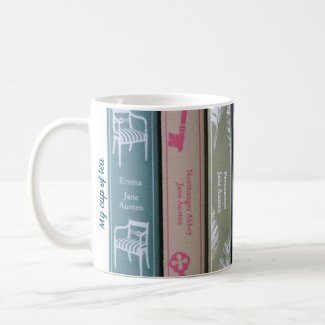
Jane Austen novels are my cup of tea
by Totally_Jane_Austen
From November 2009 to March 2010, there was a special exhibit of Jane Austen writings at the Morgan Library & Museum called A Woman's Wit: Jane Austen's Life and Legacy.

The Morgan itself owns the largest collection of Jane Austen letters in the world. Unfortunately, her sister burned most of them, so the relatively few that remain are treasures, indeed. The letters show that Austen, like Jane Fairfax in Emma used cross-writing to save paper. If you view the digitized version on the site, you can zoom in to decipher one of her letters for yourself. 
The detailed description on the letter says: 
 

Writing over the course of three days, Austen acknowledges receiving another letter from Cassandra in the meantime: "You are very amiable & very clever to write such long Letters; every page of yours has more lines than this, & every line more words than the average of mine. I am quite ashamed—but you have certainly more little events than we have." The letter is full of little events: "Mr Waller is dead, I see;—I cannot grieve about it, nor perhaps can his Widow very much," and "I want to hear of your gathering Strawberries, we have had them three times here." She reports that she is not enjoying Walter Scott's newest creation Marmion, an epic poem about a sixteenth-century battle between the English and the Scots, although she suspects she should be.


I do consider these letters a wonderful image for Austen's novels and her characters. The first read reveals something, but it takes another read from another angle to get a deeper understanding about the heart of the matter. In Persuasion, for example, Anne Elliot finds her cousin to be all that is sensible, amiable, and charming but has her friend's revelation about his ruthless selfishness assure her that he was dissembling all along. The reverse is true of Mr. Darcy, who makes a terrible first impression but later proves himself -- in a letter, no less -- to be the very best of men.

The Morgan has also fully digitized its hand-written copy of Lady Susan, and you can feast your eyes on all 161 pages: https://www.themorgan.org/sites/default/files/pdf/facsimile/AustenMA1226.pdfread  
It is really a wonderful experience to see the author's own handwriting, and it's  fully legible without any cross-writing challenges. Back in the day when I  had to look up an Oscar Wilde typescript for an assignment, I had to go to the library and handle it with gloves. Now one can just summon a manuscript at home on demand. 


Channeling Jane Austen pen


Related posts: 


Sunday, June 28, 2015

The Secret Life of Ghosts, Or Whatever Happened to Aunt Gertrude?

Image from https://upload.wikimedia.org/wikipedia/en/0/05/Mystery.png
You may never have heard of Leslie McFarlane, but odds are good that you've come across at least some of his work, if not the plays, short stories, and articles, then the children's books that have outsold any other title series for boys.

In 1976 (a year before his death) McFarlane  published an autobiographical book, Ghost of the Hardy Boys. The ghost here is the the author himself who depicted the first volumes of the Hardy Boys under the name Franklin W. Dixon. Unlike authors, like George Eliot or Mark Twin,who selected pen names for themselves the writers who churned out popular children's books for the Stratemeyer Syndicate were assigned names, which often carried on to other ghost writers as no author was considered irreplaceable.

The irony of this book is that he devotes many pages protesting that he is far more than the writer who first breathed life into the pair of boy detectives and their formidable Aunt Gertrude only to be forced to both begin and end with the series that he did not own the rights to. The 20 Hardy Boys books he wrote served as his bread-and-butter and kept his family afloat when the Depression hit and other publishers had little or no money for authors.

Work from the Stratemeyer Syndicate served as the artist's equivalent of a day job while he wrote what he considered more serious literary work, which, he did succeed in publishing after a number of false starts. The false starts are as entertaining as they are educational.

McFarlane, who is Canadian by the way, embarks on his writing career by working for newspapers, including J. Jonah Jameson, who discourages his literary ambitions because he views as pulling a potential journalist in the opposite direction needed for a newspaperman. But McFarlane doesn't give up and continues sending out manuscripts to magazines, often, not with any real understanding of what truly fits the publications. But he is not forced to simply learn by trial-and-error, as some editors take the time to give him really valuable feedback and direction.


That is one of the reasons why this book is of particular interest to people who write; it gives quite a bit of insights into the literary world. McFarlane learns to distinguish between what's popular and what's good and how to churn out what's popular for the sake of making money. But here's the rub: though he presents his Hardy Boys work as just for the sake of money, he takes particular pride in his craft, particularly in his infusion of humor and the memorable creation of the boys' Aunt Gertrude.

I put Aunt Gertrude into the title because her treatment in the reworked versions of the books issued in the later part of the 20th Century belie the fact that he does feel connected to his creation, for all his protests that it's all the property of the the syndicate. He is horrified to discover that her dramatic entrance into the series was completely cut in the new editions of the books, as demonstrated to him by a staff writer for a magazine named Bob Stall.

When Stall first approaches McFarlane to talk about the Hardy Boys series, he says he's not interested in discussing that work. After all, he feels he should be recognized for the four novels, 100 novelettes, 200 short stories, 75 television scripts, and 50 films he wrote. But Stall manages to get his attention when he shows him how the books have been eviscerated in the new editions:
They haven't just been streamlined. They've been gutted from beginning to end. Those old books were well written. They had words you could roll around in your mouth and taste. They had funny scenes. They had scenes you could wallow in. These new ones move faster all right, but too fast. There's never a place to stop and linger. That's why the old were so great for a kid. They had flavor. And now the flavor is all gone. 
Stall adds:
The books were written for a literate generation ... But not these new ones. And they'll engender an even less literate generation. 

Remember, this was reported back in 1976.  By today's standards, attention spans were long then; just look at the pacing in movies and television shows of the era compared to today's. Yet, people who remembered the previous generation noticed a difference and saw it as the sign of a trend.  Certainly, kids' books today move at an even faster pace than those that were read in the late 20th Century.

You don't have to be a Hardy Boys fan, and I assure you, I never was, to appreciate McFarlane's reaction or to accompany him on his always entertaining journey to becoming a better writer and laughing with him at his youthful pretensions, which may just remind you of your own.



Tuesday, June 17, 2014

Telling a story through letters and posts

Don Quixote is the work that many identify as the first modern novel, a work distinct from epic romances or other high-brow treatments of fictions that were considered worthy of poetry rather than prose.  Of course, that was not an English work, but a Spanish one. The novel genre only arrived in England nearly 2 centuries later, and often the stories were told in the form of letters. 
  
Epistolary novels are set on the premise of the narrator, telling the story to a correspondent. Samuel Richardson opted for the epistolary form for both Pamela and Clarissa in the 1740s About a half a century later, Jane Austen used that form in Lady Susan.  Some decade or two afterwards, Mary Shelley framed the story of the archetypal mad scientist, Frankenstein, in her novel of the same name by having the story related by the sailor who picks him up on his sea voyage in letters to his sister. However, as the novel gener took off during the 1800s, most dropped the epistolary device, even if they were written in first-person. 

It hasn't disappeared altogether, though, modern treatments tend to mix the letters with narrative, often from different points of view, as in  The Guernsey Literary and Potato Peel Pie Society Some contemporary novels substitute emails for letters and sometimes also throw in texts or social media style updates in telling their stories. I wouldn't be surprised if there is a novel that is relayed solely through tweets, possibly grouped under hashtags rather than traditional chapter titles. 


But I wonder if anyone has attempted to tell a story through an online community bulletin board. I know that some reveal an awful lot about their lives through their posts -- about having children, having financial difficulties, attempts at getting a job, attempts at getting a loan, divorce, and calls for outright handouts.  That's all from one person's posts over the past 3 or 4 years. For writers of fiction, I thought that such an account could  form the central line of a narrative from which several key characters branch off. 


Related interest:
http://uncommoncontent.blogspot.com/2013/06/jane-austens-heroines-from-extroverted.html
http://uncommoncontent.blogspot.com/2014/02/poetry-difference-between-practice-and.html


Thursday, August 29, 2013

Ethics and editorials

As a freelancer, I am always happy to hear of offers for writing jobs. Sometimes I decline because either no pay or very low pay is offered. But today I ran into something completely different: an offer to pay for articles I publish elsewhere in the interest of PR. This is how it works:


This type of PR freelance work is very trendy in the digital publishing space and I've noticed a lot of writers unaware of the potential. With your writing and contributing experience with sites like  ___ and others I think we would be a fantastic team. I would pay between $300 - $500 for these sites alone and more for others.
Please check out the project details below: I am currently working with writers in a wide variety of fields and would love to add you to my network. I know that many top websites do not pay their contributors, so I would like to offer this paid freelance work as a way for you to create revenue from your current unpaid or paid contributor jobs.Second half pay refers to the payment you will receive once you publish an article on any given site. This second half process includes things you already do like pitching, taking on assignments, submitting articles to the editor, and publication.For example, if we decided to work on a project for the LA Times:1. You would pitch an idea or take on a story given to you by the editorial team at the LA Times.2. You would come up with an angle for the story organically, and let me know if I have any sources for quotes, reference that would fit into your story.3. If so, I provide assistance in helping gather sources for the story to include in the article.4. You write the story and I pay you for your work ($X for LA TImes).5. You submit to predetermined publisher for publication (i.e. LA Times, etc.) and once published I pay the remaining portion of the payment (i.e. $X for publication).What I get out of it is working with you to create the articles before you publish so I can integrate my clients as sources as they relate to articles you're writing. If you decide a link to my client's site/page is relevant and makes sense within your article; then I will pay you for writing and publishing that articles due to the added exposure you provide to my client. I will also help you with SEO and title, subheading, keyword research for your articles so they rank better in search engines if you decide to collaborate with on any given article.Links are valuable in the online publishing space, so anytime you think one of my client's sites is relevant and would like to use them as a source, we can collaborate and use this payment structure. 


I'm not altogether naive. I know that content does get skewed somewhat by publishers who are sponsored by or who run ads for businesses. Sometimes it is done with more subtlety than others. For example, I spoke with someone whose business is getting paid by individuals and organizations who want to be represented in Wikipedia. The writing is all done to Wiki standards and has to sound objective, but the clients are the ones paying to get it done so that they will have that kind of web presence. 
 I also realize that some business reps are happy to talk to me because they value the exposure they get for free in my articles. However, it never occurred to me to seek payment from the sources of information or from rep of said source. Doing so seems to open up the potential for conflict of interest. Even if the client quotes are perfectly sound, having to take them into account because of the payment rather than because they are the best ones for the article is also a compromise of journalistic integrity.I ran this by someone who has been in the publishing industry a lot longer than I have. While he conceded that it could be construed to be somewhat unethical, he said that it was "not unlike traditional PR, " in which case the contact would pitch client sources directly to an editor, though money would not be offered in that case.  I've had a bit of that before: people wanting to get  what they are doing publicized.  But the reality is that I can only publish approved topics, and not everyone's business interest will fit the context. And I certainly can't adjust the SEO for the pieces that are subject to editorial changes.  Somehow, I don't think the publishers would take to kindly to my taking payment from another party when they already pay me for the writing work.  And that does have the potential to backfire. 


Also I find it questionable from a legal standpoint.If bloggers who receive compensation for their product endorsements are required to disclose that fact, why would it be legal for writers to take money from people who are pushing a particular agenda on another publishing platform without full disclosure?   Even if there are no legal pitfalls, though,  I don't like getting involved in anything that even smacks of underhandedness.


We would work together to craft stories and subjects to post on websites you currently contribute to, while collaborating on: topics, subject matter, sources, links, etc. in each article. Each freelance project involves paying a sum upfront for your time to create the article and the second half once the content is published by you on a site.


Obviously, the assumption here is that freelancers feel underpaid, as many publishers really do offer ridiculously low fees or even no pay at all (as Huffington Post is infamous for)  because the writer is given such wonderful exposure. The boards who do engage in that should now consider the potential downside to having writers who find other ways of making their writing work pay. 

Just as I tell clients who hire me for web content that I won't create testimonials for them, I don't like having to misrepresent a directed piece as an objective one. This is the kind of subtle moral question that George Eliot looks at in Middlemarch. One character lets monetary considerations influence a major decision, and another absolutely refuses to compromise on her moral scruples at the cost of an inheritance. Some of us are just too burdened by integrity to take advantage of all opportunities.

Sunday, September 23, 2012

What do Cynthia Ozick and Snoopy have in common?

Their writing style and experience of  rejection
Cynthia Ozick's response to the routine of rejection from The New Yorker 
in a letter written on January 5, 1962 is one of the discoveries from the magazine's files shared in from   It opens just like Snoopy's query letters

Gentlemen,
For a number of years now I have been sending you poems, and until very recently I have always found you entirely reliable. Exactly seven days after each new poem has been dropped into the mail, it has come punctually home, accompanied by that little rejection slip of yours marked with the number 1 in the left-hand bottom corner. (You know the one.) You have, as I say, been altogether faithful and dependable. For example, it is never six days, it is certainly never eight or nine days. It is always seven days to the minute, and your conscientious devotion to precision all these years has been matched, to my knowledge, only by the butcher's deliver-boy, whose appearance is also predicated on a seven-day cycle.

This time, however, you have failed me. A poem of mine, entitled "An Urgent Exhortation to His Admirers and Dignifiers: Being the Transcript of an Address Before the Mark Twain Association by Samuel Clemens, Shade," reached you on December 18, 1961, and, though eighteen days have already passed, a daily inspection of my letterbox yields nothing. I have enough confidence in your hitherto clean record of never considering anything I have submitted not to be tempted into the unworthy suspicion that the delay is actually caused by your liking this poem. What has been shattered, I must admit, is my sense of serenity, of certitude, nay, of security — not to mention my sense of rhythm. Does this mean you can no longer be relied on to conform to the seven-day schedule you have consistently adhered to in the past? In short, is the Age of Doubt truly upon us? O tempora!

Or (but I venture this with a cheery hopefulness I do not dare to feel) is it only that you have finally gone and lost my manuscript? I realize I am probably being too sanguine in putting forth this rosy possibility, but I guess I am just basically an optimistic sort. Please reassure me that this, rather than some flaw in your clockworks (even to contemplate which disillusions me hideously), is the real nature of the difficulty.


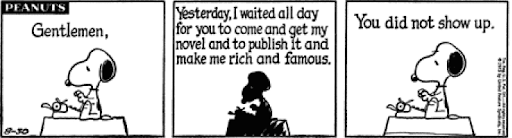
I expect your answer in seven days. Seven days later, she must have found herself in Snoopy's position here:
According to Yagoda, there was no answer in the files, though Ozick's stories were, eventually, published by the magazine.

As we know, Ozick went go on to achieve fame as a writer. Snoopy also achieved fame, though not necessarily for his literary endeavors. Still, his persistence remains an object lesson and inspiration in the book Snoopy's Guide to the Writing Life

I appreciate your attention and generosity. Tips accepted via Zelle.

If you enjoyed this content, you can support my work with a tip or purchase from my Zazzle store.

If you enjoyed this content, you can support my work with a tip or purchase from my Zazzle store.
Find great gifts and party accessories for literature lovers in all price points.