Showing posts with label Disney. Show all posts

Thursday, July 2, 2026

How "The Other Bennet Sister" subverts narrative convention


We've seen it countless times in romance films. The unassuming heroine who never thought of herself as a beauty gets a makeover that makes her the most stunning woman at the ball. 

What we've been conditioned to expect 

Disney has practically patented this plain to princess trope from the time that it showed the magical transformation of Cinderella's torn dress into a sparkling gown to the depiction of beauty professionals smoothing the bushy-browed, curly-haired, bespectacled Mia into the general beauty standard  ahead of dressing her in her ball gown. 

In the conventions of such films,  a heroine who does not shed her ugly duckling veneer and become the graceful swan we expect to see is unthinkable. And that is what makes The Other Bennet Sister so  daring in challenging it.  


Being the odd one out

The Other Bennet Sister is Mary's story of how she comes into her own identity and happiness. Of course, growth and change is part of that story. But the usual account of a girl's metamorphosis into a beautiful woman who only gets her due after removing her glasses, doing her hair, and wearing the right clothes is replaced by the confidence that allows Mary to be herself instead of trying to impress others and win parental approval. 

In the book, Mary keeps applying herself to books largely to try to win her father's notice and affection. That is not really shown in the adaption, which highlights more of her awareness of constantly disappointing her mother because she is not pretty enough or lively enough and has the gall to wear spectacles. In her parental home, where her sisters have paired up without her and her parents either ignore or criticize her, Mary has no one to turn to.

But that all changes when the Gardiners take her in. Her aunt does everything possible to make Mary feel at home and to build up her confidence that Mrs. Bennet's constant criticisms have undermined. And we have the requisite new wardrobe for the heroine as she makes a switch from her usual drab colors, though it's all about Mary's self-esteem rather than the usual makeover.

Though she never blossoms into beauty, Mary with her glasses and unfashionable clothes manages to attract two suitor. Tom Hayward and Will Ryder enjoy her company and conversation because she is so different from other women they've encountered and says what she really thinks.   


Clothes do not make the woman, but choosing them does

Mary's new  spring green gown
Mary's new clothes are handled very differently in the book and in the adaption. The novel gave greater weight to Mary's feelings of guilt concerning Mr. Sparrow at the Assembly ball. Associating that with a becoming cream and gold gown that she had treated herself to for the occasion make her deny herself pretty dresses afterwards. Wanting to boost her nieces confidence, Mrs. Gardiner makes the argument her that she deserves to dress in smart clothes as a reflection of how she values herself and even persuades her to allow Elizabeth -- who wishes to make amends for having played a part in Mary's embarrassment when told to stop playing piano --to pay for it. 


In contrast, in the adaption, Mary has come to the Gardiners as an interim governess, and her aunt convinces her that the position includes a dress allowance. She urges Mary to choose the fabrics she wants on her own and refuses to direct her in any way. The resulting gowns are not what would have been called "smart" at the time. The spring green gown red gown is particularly unflattering. 

Yet, as she tells Miss Baxter, it makes her feel bold. That statement proves that Mrs. Gardiner achieved her aim of bolstering her niece's confidence in herself and her ability to choose for herself, regardless of how fashionable she may appear.  

Mrs. Bennet attempts to undermine that when she offers her own commentary on the red dress and forces Mary to wear Elizabeth's gown at dinner to look more attractive to Mr. Ryder. (None of this occurs in the book.) Mary wears the blue gown that her sister wore to the ball some 2-3 years and shows her discomfort by fidgeting with the neckline. 

Elizabeth selecting her gown for the ball

This dress is the one that Elizabeth selected over a yellow one in order to disassociate herself form her mother who was wearing a similar color. Mary will echo making that choice when it comes to deciding what to wear for the hike up Scafell Pike. 


Mary chooses her blue plaid gown
Narrating her actions, Mary declares, "I had made my choice!" when she selects her own blue gown -- the plaid one she has worn many times before, though she pairs it with a fuchsia spencer. She wears the same combination when she is reunited with Tom Hayward and finally gets the romantic resolution she had hoped for.

The choice she had made was not just about her clothes but about taking control of her own life. One was marrying Tom rather than much richer Ryder. The other -- an invention of the adaption -- was to put all her learning to use as a kind of tutor/governess and pursue a career even as a statement of valuing herself beyond attaining the position of wife. That is Mary declaring her own independence from conventional standards as she pursues her own form of happiness. 

Related: 
The Other Bennet Sister: Celebrating Mary Bennet

The Other Bennet Sister: Celebrating Mary Bennet
by Totally_Jane_Austen

"The Other Bennet Sister" is Closer to Jane Eyre than Jane Austen

Jane Austen and Autism

Jane Austen: Love and Money
Jane Austen at the Morgan
Love and Limerence in Jane Austen
Observations on Jane Austen's Emma
Pride, Prejudice and Persuasion: Obstacles to Happiness in Jane Austen's Novels
Three Janes, Two Governesses, and the Abolitionist Movement
The Big Bow-wow & Bit of Ivory
Jane Austen's Heroines
Jane Austen and Capability Brown
Pride and Prejudice in Job Applications
Jane Austen at 250
Many Happy Returns, Jane Austen

Friday, July 17, 2020

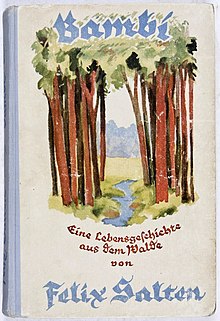
The Bambi Backstory

While reading Nathalia's Holt's The Queens of AnimationThe Untold Story of the Women Who Transformed the World of Disney and Made Cinematic History I learned a number of surprising things about the development of Disney's films - both the most iconic and the ones that do not survive on video because of their overt racism (ike Songs of the South) or the ones that have been censored for the same reason (like Fantasia).

But for me the most surprising  revelation of the book was about a Disney movie I've never even seen. Before Bambi made it to film, it was a novel written by Felix Salten and called Bambi: A Life in the Woods.

The author was born in Budapest in 1869, though his family moved when he was a month old to Vienna. The motive, as Holt explains (96) was to gain greater opportunity in a city that had begun granting some rights to Jewish resident in 1867.

Salten had a strong sense of Jewish identity that found expression in his passion for Zionism. Like the fictional Mordechai in George Eliot's Daniel Deronda, he was a big advocate for a Jewish homeland.

Salten's novel first saw print in the form of newspaper serialization in Vienna in 1923.
Just over a decade later, the copies of the book were thrown on Nazi bonfires.  Holt  explains (p. 26), "The book was banned not only because of the author's Jewish heritage but also for its metaphors about anti-Semitism. "

While this is a revelation for people familiar with the deer as depicted by Disney animation, back in the early 20th Century, people understood the allegory. Even the description of the butterflies touches on the experience of people who cannot find any permanent home "'always searching further and further because all the good places have already been taken,'" Holt quotes (26).

 Bambi was a means of exploring the themes related to Jewish identity and surivial.  The deer in this story are not carefree creatures but burdened by the persecution they endure from hunters and who have to consider if assimilation is the path to take to survive.

 While some animals adopt "If you can't lick 'em, join 'em" to try to survive with hunters, that strategy fails them, as illustrated by a character who believes wearing a halter will protect him who ends up shot by a hunter. Likewise, the dogs in the novel are described by Bambi's father thus: "'They pass their lives in fear, they hate [Man] and themselves and yet die for His sake'" (quoted in Holt 96).
Though Holt comments on how very appropriate that was for the time at which Bambi is made, it really is a perennial theme for people who have repeatedly been displaced and threatened.

The book is interesting also for the glimpses into working as a woman in what was very much a man's field, and the bad old days of sexism, racism, and persecution of Asians under Roosevelt. If aviation is also of interest, you may enjoy her tangents about the animators who also aspired to fly and their achievements in the air as well as on film.

Sunday, February 10, 2019

True love meets marketing

In email from Modcloth


from Banana Republic
When a holiday invented on a TV program becomes a real thing, we can only marvel at how right Oscar Wilde was in declaring, "Life imitates art far more than art imitates life."


Galentine's Day was born in a script for the 22nd episode of Parks and Recreation that first aired on NBC on February 11, 2010. In the episode named for the newly invented holiday, the holiday is presented not to supplant Valentine's Day but to offer a supplement to it. It sets aside February 13th as the day to celebrate women's friendship,with gifts and gatherings.


As someone who has never watched the program, I had not heard of Galentine's Day until a couple of years ago when businesses started to latch on to the day as cause for marketing clothes, cosmetics, brunches, etc. In fact, this year, I already received emails from the likes of Target, ModCloth, Gap brands and Olay with messages like the ones I copied here.

Clearly, marketers know an opportunity when they see it (even if some publications on marketing have failed to take note) and by 2019 Galentine's Day is a marketing holiday in its own right. Granted, Galentine's Day has not yet made it to the status of being counted among the holidays covered by National Retail Foundation (NRF). However, the force behind the Galentine's Day movement is a factor in the revision of Valentine's Day itself.

 The Evolution of Valentine's Day 

A 2013 article entitled "The Reconceptualization of Valentine’s Day in the United States: Valentine’s Day as a Phenomenon of Popular Culture"argues that the holiday was reborn in the US in 1840s, largely due to the rise of marketing, which extended the celebration through the promotion of gifts and cards: " Even though the holiday historically involved primarily young men and women, the range of individuals included in the celebration of Valentine’s Day was expanded in the United States to any and all ages through aggressive marketing techniques directed at both the young and old, consequently increasing the amount of Valentine’s Day consumers."

Certainly, there is no let up of marketing around such a lucrative holiday. This year, the NRF estimates a record-breaking  $20.7 billion will be spent on Valentine's Day, and that's even in the case of just 51 percent of people saying this will be celebrating it. That's because those who are spending are spending more, and not just on the red roses and romantic dinners. Cards and gifts for friends and indulgences one buys for oneself are propping up those spending amounts. As the NRF itself observes, the spending patterns for Valentine's Day have changed over the past decade.

The Galentine's Day Factor and Modern Princesses

The change noted by NRF fits well with the timing of the rising influence of the Galentin'se Day Phenomenon over that same period of time. Even for those who do not set aside February 13th as the day to mark the value of female friendships, the attention it -- among other key relationships outside romantic ones -- deserve has taken over a greater share of Valentine's Day itself. For an easily accessible barometer of pop culture, we'll look at the evolution of  Disney movie plots.

The cultural shift in celebrating various loves in life can even be seen in Disney movies of this period. While the classic princess stories, starting with the 1937 Snow White,  had always culminated in finding her prince, that has also evolved. Let's look at 2010: in Tangled, Rapunzel does meet a man she falls for her, he is not a prince, and they do not even commit to marry by the end of the film. So there is some deviation from the classic romantic plot there. By 2012, there is no romantic interest interest offered at all for the heroine of Brave who is motivated by her love for her family. But the really big change arrives the following year in Frozen in which the trappings of romantic love are presented only to be rejected, and the transformative power of true love is shown to be the bond of sisters.

True love, no longer the province of a  princess bride now can be taken to apply to friends and family, and so Valentine's Day itself is being redefined as a holiday of love that is not bounded by romantic tropes. Of course, marketing will take advantage, and we even have sellers who can take advantage of those whose spending is devoted to "anti-Valentine's Day" gifts.

I appreciate your attention and generosity. Tips accepted via Zelle.

If you enjoyed this content, you can support my work with a tip or purchase from my Zazzle store.

If you enjoyed this content, you can support my work with a tip or purchase from my Zazzle store.
Find great gifts and party accessories for literature lovers in all price points.