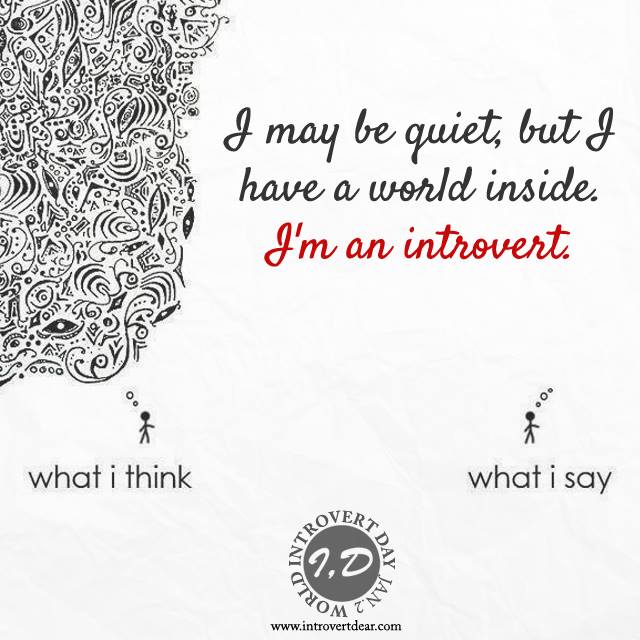
Within the space of a number of weeks, I read three books on introverts. I started with most recent and most publicized within that category: Susan Cain’s Quiet: The Power of Introverts in a World That Can't Stop Talking(2012)
Unlike the authors of the other two books,
Susan Cain is not a psychologist. She actually started out as a Wall Street
lawyer. Having recognized her own ability to negotiate based on introverted traits and
became a consultant and writer. Her book reflects some careful research and
interviews with some insight based on her own experience.

The pieces of the book may have functioned as
separate articles. She talks about quiet strength in heroic figures like Gandhi
and Rosa Parks – who partnered with the more extroverted Martin Luther King, Jr.
She runs through the problem for introverts
at school who are utterly silenced by the dynamics set into play by group divisions
and work places that that torture introverts
with open plans. She also looks at the contrast between Asian (quiet,
introverted) culture and American (louder, extroverted) culture and how those
caught between two worlds cope.
While Cain is generally very positive about
introvert traits, the book does include sections on faking it as an extrovert,
which she calls “self-monitoring.” It
becomes necessary for any introvert whose life’s passion includes the necessity
of interacting with groups of people, whether it is a professor who must
deliver lectures or an author who must promote her book.
The second book I read on the topic was The Introvert Advantage: How to Thrive in an Extrovert World by Marti Olsen
Laney (2002). I found this one seriously annoying at times. The fact
that the author insists on referring to introverts as “innies” made me want to take
Dorothy Parker’s advice about a certain novel and throw it with great force.
However, I refrained from doing so because it was a library book and I was
resolved to follow through on reading, for persistence is one of the great
introvert traits.
Laney’s book is just loaded with advice, much of which is not particular to introverts –
like pack
sunscreen, drink water (add some lemon juice to pick yourself up) and
dress in layers to assure comfort. She justifies the inclusion of such by
saying that introverts tend to have sensitive skin and also may be more
sensitive to temperature changes with a tendency to be cold. Well, I do slather
on the sunscreen but not because of any introvert traits. Such practical but
somewhat irrelevant advice is a minor annoyance, as far as this book goes.
What is more problematic is the way she constructs an introvert. She stresses that introverts are set in a “throttle-down” mode which makes it take longer for them to process information and more stimulant-averse. That may be true, but really I have not found that being an introvert makes me any slower than other people. In fact, I move pretty quickly and efficiently.
The thing that most bothers me about Laney is that her book title is completely misleading. The way introverts come off, poor, delicate, slow creatures who are easily overwhelmed, they really have no advantage. In fact, in order to survive they simply must learn how to act and talk like an extrovert.
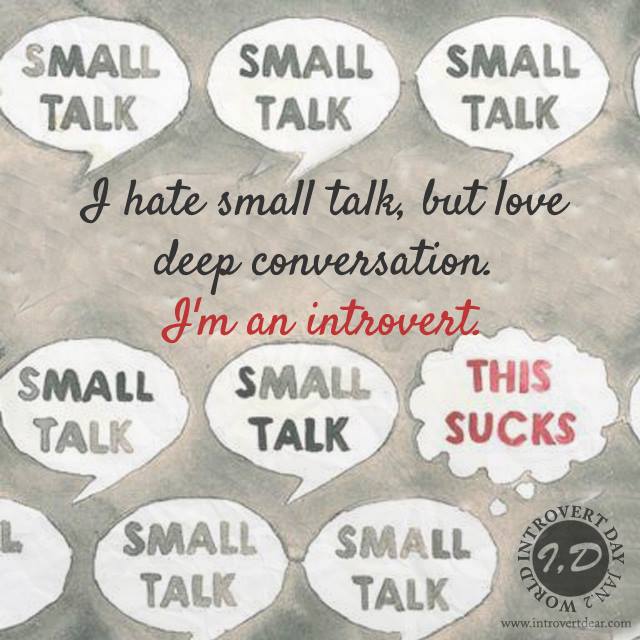
The lowest point for me in the book is when she offers suggestions to make small talk that include gems like “Isn’t the food delicious?” and “Isn’t this a lovely home?” Yup, that’s just what introverts despise – empty conversation just to fill in the silence. If you have to resort to such stratagems, you may want to consider Lincoln’s observation, “Better to remain silent and be thought a fool than to speak out and remove all doubt.”
In contrast to Laney's approach, Laurie Helgoe’s book, IntrovertPower: Why Your Inner Life Is Your Hidden Strength (Sourcebooks 2008) is the ultimate introvert manifesto. It pretty much say, “We make up at least half the world’s population; we have the right to be ourselves and not conform to any other standard.” She spends quite a bit of time debunking the perception that introverts make up only 1/3 of the world and so are overwhelmed by the majority made up of extroverts. She points to flaws in statistics and identification to make the case for over 50% of people qualifying as introverts. Cain does touch on the perception of numbers but does not make the larger number central to her approach.
I admit I found this book a lot more fun to read than Laney’s. It also flowed rather more organically than Cain’s. She does touch on Japanese culture, as Cain did, but in a much more brief and personalized way. The focus of the book nearly always comes back to Helgoe’s assertion of being an unapologetic introvert. That is someone who does not buy into the argument that she is missing out on the fun that extrovert have: “The Socially Accessible introvert looks like an extrovert on the outside and sees extroversion as a bar that he or she can never quite reach. These individuals are often very successful in social arenas, but fault themselves for not having fun.” That leads to feelings of “alienation from self” which can result in depression (p 27).
Her positive spin on introvert traits really resonated with me, like the definition on p. 7:
being an introvert does not mean you’re antisocial, asocial, or socially inept. It does mean that you are oriented to ideas…. It means that you prefer spacious interactions with fewer people. And it means that, when you converse, you are more interested in sharing ideas than in talking about people and what they’re doing. In a conversation with someone sharing gossip, the introvert’s eyes glaze over and his brow furrows as he tries to comprehend how this conversation could interest anyone. It is also important to recognize that it’s not just a matter of preference, but of survival:
“For introverts, being ‘talked to death’ is very much like being beaten on the head. … most of us feel drained of life energy. Talk can hurt us, and protecting ourselves from harm is not rude” (133).
In contrast to Laney’s advice for making conversation in social situations, Helgoe insists that you can be an introvert when interacting at a party: “Be real. If you want real, be real. You don’t have to keep small talk small. You can be polite without selling out. You can acknowledge someone without grinning from ear to ear. Let your depth be evident in your manner, and the people you meet will actually meet you.” (p. 153)
Don’t…
Introduce
topics that bore you – i.e, ‘Where do you work?’
Ask
questions that can be answered with ‘fine’ – i.e., ‘How are you?’
Do…
Ask
question you don’t know the answer to – i.e., ‘When did you first know you
wanted to teach?’
Ask
for personal definitions – i.e., ‘Help me understand. When you say the film was
‘dark’ what does that meant to you?’
Observe.
Notice how it’s going. Allow silence. Don’t try too hard.
Helgoe includes the biographical detail that
she came from a family of ten children but chose to have only two because of
her introverted nature. While very
devoted to her husband and children, she does not feel guilty about taking time
– even overnight retreats – for herself. Like Cain, she likes to coffee bars,
and will park herself in one for hours. But her preference is to travel out to
one not in her neighborhood. In the inverse of the assumption of the “Cheers”
theme song, sometimes she wants to go where no one knows her name. She wants to
be around people that she can choose to engage with – or not – with no
obligation to catch up and converse if she wishes to remain alone in the crows.
The three books touch on the pleasures and perils of mixed marriages, as
conflict is inevitable when an introvert is wedded to an extrovert. Cain offers a nice example of a compromise
that does not make either side give in (see the-marriage-of-opposites), while Laney says she and her husband take turns selecting vacation
destinations (I noticed that Amazon includes The Introvert and Extrovert in
Love: Making It Work When Opposites Attract by Marti Laney PsyD
MFT and Michael Laney (2007), though it has only 9 reviews)
All three introvert writers are women married
to extroverts. They also all happen to be mothers – with Cain and Helgoe both
identifying their children as boys, while Laney is already a grandmother. So they do have much in common, and the books
do, inevitably offer some overlap. However, each has her own take on what is
central to the introvert experience.
Cain’s is quiet, Laney’s seems to be a
slower pace, while Helgoe’s is escape from intrusion. Now, if I were to come up with my own take on
introversion, it would be autonomy – being allowed the space and the
independence to do what one wants without having to check with another.
Related posts
Working alone
The Great Introvert
Jane Austen's Heroines Ranging from Extroverted Emma to Introverted Fanny
Happiness is
Views on Boundaries
Public or it didn't happen