Sunday, December 7, 2014

Views on Boundaries

Personality types and introversion recently came up on one of the online boards  on which I comment. It made me consider another aspect of the difference between introverts and extroverts. It's not just a matter of people who need to be alone to recharge in contrast to those who need to be around other people to feel energized. There are real differences between the two in how they view the way people should relate to each other, and that can give rise to misunderstanding or the wrong assumptions, and, yes, I'm thinking of a particular incident.

From what I've observed, introverts assume that boundaries should be in place unless otherwise specified, whereas extroverts are more likely to assume the opposite. Consequently, while an extrovert would assume it is neighborly to drop in on someone, an introvert would rarely do so unless s/he is expressly invited to come at a particular time. That doesn't mean the introvert doesn't like his/her neighbor but that the assumption is that people want to be left alone unless they tell you otherwise.

Now to get to the particular incident of different assumptions of what constitutes polite behavior, here's the example. I had a friend who stayed in the empty house of a neighbor of a relative once. Said relative told me afterward that the friend was shocked at what the friend did. I was imagining all sorts of horrific scenarios and then was told that the really shocking thing was this: the friend did not pick up the mail that was put through the door slot. Now if you're an introvert, your assumption of boundaries would tell you to leave as much of someone else's stuff alone as possible. That would extend to handling someone else's mail that just happened to be delivered through the door. It takes an extroverted mindset to assume that showing such respect for someone else's privacy is a lack of courtesy.

I'm now adding one other example about circumspection with respect to boundaries, as it just happened. I commented on someone's post and referred to a Talmudic story to make my point. Someone else said I was misrepresenting it and said I got the name wrong. In truth, I would do the same, but only if I were 100% sure that the other person got it wrong.  

In this case, the name I had written was correct. I ascertained it again for myself by getting out the primary source. When I pointed that out, the woman who had disagreed with me had to concede that point and then made excuses for herself that she had just been on a long flight, etc., etc. I understand making mistakes when tired. I do that myself and have even been guilty of making typos I would normally spot. However, I would not ever challenge someone on the basis of at hazy recollection, and then say, well, what do you want from me, I was tired.

Sunday, June 29, 2014

Going for the brass ring

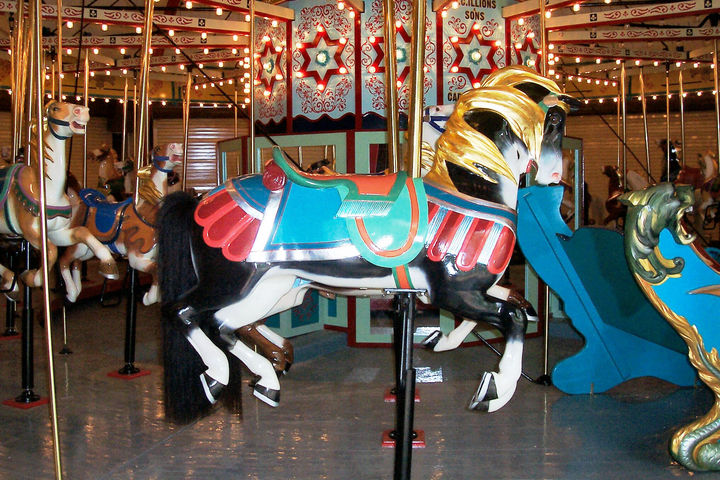
Today I rode the  carousel at Hempstead Lake State Park. Counting my daughter (who did not want to go on by herself) and one other kid, the total number of riders came to three. On the round just before ours there were just two riders. I suppose carousels have fallen out of favor, though they actually have a much longer history than I suspected. 
On the cashier's counter was a pile of papers with some more information about the carousel. Unfortunately, the powers that be at Hempstead Lake State Park did not bother to upload that to the park's site. For example, the historic carousel is named for Heckscher  because August Heckscher donated it to the park in 1931. It continued operating until 2001  (though according to this, it faced a crisis in 1981. In 2003, the carousel was taken apart and shipped across the country to Carousel Works in Ohio  for a full restoration at a cost of $400,000. The carousel was put back in place  and once again opened to the public in 2005.

 Pictures and some more details about its history are in About article by . What's interesting about the major restoration is that it truly lived up to its name. writes that in the decade between 1951 and 1961, eight of the original horses were replaced by aluminum ones. During the restoration project 10 years ago,  those replacements were taken out. In their place "four original Illions carved horses that had been found in storage, as well as two Illions horses that were taken from a carousel in Pennsylvania, and two new horses that were carved in the Illions style by Carousel Works, Inc." were put in their palce. 

The handout at the carousel also gave some general history of carousels, which is easier to find sourced online. Specificially, what we consider a plaything of children -- and the young at heart, of course -- actually started out as an exercise in knightly combat. Wikipedia covers that in its entry on carousels:


The word carousel originated from the Italian garosello and Spanish carosella ("little battle", used by crusaders to describe a combat preparation exercise and game played by Turkish and Arabian horsemen in the 12th century).[3] This early device was essentially a cavalry training mechanism; it prepared and strengthened the riders for actual combat as they wielded their swords at the mock enemies.
By the 17th century, the balls had been dispensed with, and instead the riders had to spear small rings that were hanging from poles overhead and rip them off. 


The same point is made in a NYC report http://www.nyc.gov/html/lpc/downloads/pdf/reports/2528.pdf posted online  in connection to a carousel in Queens (which wasn't in operation when we visited the park a couple of years ago). Starting out with an eye to SEO, the NYC report includes all variant on name and spellings: "including carousel, carrousel, carousell, carousal, carosello, merry-go-round, roundabout, and steam riding galleries. " However you spell it, the mechanism dates back to the 16th century:  "Following Henri II’s unintentional death during a jousting match in 1559, French horsemen began practicing with straw and wood figures attached to rotating circular frames."

The NYC report includes  this  citation: 
Much of the information found in this section is found in Frederick Fried, A Pictorial History of the Carousel  (New York: Vestal Press, 1964, various editions), Lisa English, “Roundabout,” Metropolis (July/August 1990), 57-69, “Forest Park: The Carousel,” viewed at http://www.nycgovparks.org/parks/forestpark/highlights/12049.  Also see Richard W. Johnston, “The Carousel,” Life (August 27, 1951), 100ff.; Robyn Love, “The Painted Ponies of Queens: Celebrating the Magic of the Carousel,” poster, City of New York Parks & Recreation, 1995, LPC files; Eric Pahlke, Treasures from the Golden Age: East Carousels (forthcoming, 2013). It is worth noting that most essays and books that are devoted to carousels lack specific citations and references to primary sources. 

In the Hempstead Lake State Park handout, it explained that the brass ring that used to adorn carousels represents what the knights tried to catch as a test of skill. That was later adapted for riders of the ride for amusement around the beginning of the 18th century, according to the NYC report cited above.  The oldest one still around is in Germany. It was built in 1780, and there is more information about it here

As for the power used to propel the carousels, according to the NYC report,  the rides were first moved by serfs, then oxen. Later carousels incorporated steam power. In 2011, GE set up a solar powered carousel at South Street Seaport that it called Carousolar. But the ride was not intended as a permanent fixture in New York. 


I appreciate your attention and generosity. Tips accepted via Zelle.

If you enjoyed this content, you can support my work with a tip or purchase from my Zazzle store.

If you enjoyed this content, you can support my work with a tip or purchase from my Zazzle store.
Find great gifts and party accessories for literature lovers in all price points.