Thursday, August 20, 2015

What do you expect?

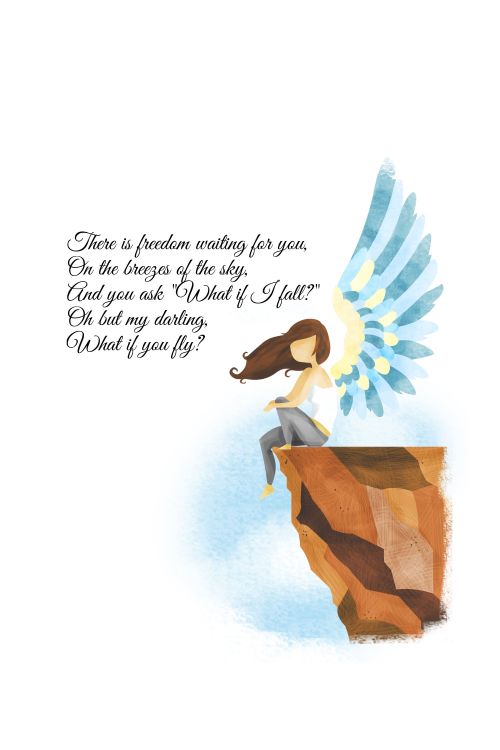
Today I heard someone say what crystallized for me what exactly irks me about the popularization of the meme pictured at right. 

The initials after the quote stand for Erin Hanson, a twenty-year-old Australian who penned these lines while still in her teens:


There is freedom waiting for you,
On the breezes of the sky,
And you ask "What if I fall?"
Oh but my darling,
What if you fly?


On that site, the picture used to illustrate the poem shows a drawing of a girl sitting with her legs dangling over a cliff and a pair of colorful wings on her back. 

The theme is a twist on "nothing ventured, nothing gained." You have to assume some risk to gain the potential benefit of advancing and changing. That's quite true, but I'm still bothered by the way this is set up because we all know what will happen to anyone who tries to jump off a cliff with just a pair of costume wings. 

A life devoid of hope and dreams is pretty gloomy. However, a life based on false hope and irrational expectations is pathetic and sad. So what do you do? You keep your expectations within the realm of possibility and keep the risks within check.

Perhaps that's my own parental bias, but I see it this way. You don't do your children any favors by encouraging them to try things that are not only beyond them but would cause them injury. In other words, you don't tell your kid to go ahead and climb a mountain until s/he has completed training for such a feat. 

What you can do is tell a kid to try to ride a bicycle even if there is a risk of falling and injury (I broke my ankle twice by falling off a bike) because it is a rational expectation that the kid will pick up on the balancing skills and the risk of a broken limb along the way is a manageable one. 

Aspiration is a good thing, but an expectation that one will achieve actual flight is dangeorusly delusional. Before anyone says I'm being too literal, I assure you, I'm very adept at abstract thinking. My point is  not just about defying the laws of physics but about the larger idea of setting up expectations.  

What's attainable, and what's worth the risk? That's something that everyone has to answer for him/herself. Would I venture into woods near dark? No. But I would venture on trails with plenty of hours of sunlight and adequate water. 

From my perspective, venturing out, say to go for an interview, meet friends, or see a new place is worth the risk of hitting traffic or getting somewhat lost, so long as you have a way to get back on track without getting into seriously dangerous areas.  But if I wanted to fly, I'd take a plane. 

Related post: http://kallahmagazine.blogspot.com/2015/03/modeling-behavior-for-child.html


Sunday, June 28, 2015

The Secret Life of Ghosts, Or Whatever Happened to Aunt Gertrude?

Image from https://upload.wikimedia.org/wikipedia/en/0/05/Mystery.png
You may never have heard of Leslie McFarlane, but odds are good that you've come across at least some of his work, if not the plays, short stories, and articles, then the children's books that have outsold any other title series for boys.

In 1976 (a year before his death) McFarlane  published an autobiographical book, Ghost of the Hardy Boys. The ghost here is the the author himself who depicted the first volumes of the Hardy Boys under the name Franklin W. Dixon. Unlike authors, like George Eliot or Mark Twin,who selected pen names for themselves the writers who churned out popular children's books for the Stratemeyer Syndicate were assigned names, which often carried on to other ghost writers as no author was considered irreplaceable.

The irony of this book is that he devotes many pages protesting that he is far more than the writer who first breathed life into the pair of boy detectives and their formidable Aunt Gertrude only to be forced to both begin and end with the series that he did not own the rights to. The 20 Hardy Boys books he wrote served as his bread-and-butter and kept his family afloat when the Depression hit and other publishers had little or no money for authors.

Work from the Stratemeyer Syndicate served as the artist's equivalent of a day job while he wrote what he considered more serious literary work, which, he did succeed in publishing after a number of false starts. The false starts are as entertaining as they are educational.

McFarlane, who is Canadian by the way, embarks on his writing career by working for newspapers, including J. Jonah Jameson, who discourages his literary ambitions because he views as pulling a potential journalist in the opposite direction needed for a newspaperman. But McFarlane doesn't give up and continues sending out manuscripts to magazines, often, not with any real understanding of what truly fits the publications. But he is not forced to simply learn by trial-and-error, as some editors take the time to give him really valuable feedback and direction.


That is one of the reasons why this book is of particular interest to people who write; it gives quite a bit of insights into the literary world. McFarlane learns to distinguish between what's popular and what's good and how to churn out what's popular for the sake of making money. But here's the rub: though he presents his Hardy Boys work as just for the sake of money, he takes particular pride in his craft, particularly in his infusion of humor and the memorable creation of the boys' Aunt Gertrude.

I put Aunt Gertrude into the title because her treatment in the reworked versions of the books issued in the later part of the 20th Century belie the fact that he does feel connected to his creation, for all his protests that it's all the property of the the syndicate. He is horrified to discover that her dramatic entrance into the series was completely cut in the new editions of the books, as demonstrated to him by a staff writer for a magazine named Bob Stall.

When Stall first approaches McFarlane to talk about the Hardy Boys series, he says he's not interested in discussing that work. After all, he feels he should be recognized for the four novels, 100 novelettes, 200 short stories, 75 television scripts, and 50 films he wrote. But Stall manages to get his attention when he shows him how the books have been eviscerated in the new editions:
They haven't just been streamlined. They've been gutted from beginning to end. Those old books were well written. They had words you could roll around in your mouth and taste. They had funny scenes. They had scenes you could wallow in. These new ones move faster all right, but too fast. There's never a place to stop and linger. That's why the old were so great for a kid. They had flavor. And now the flavor is all gone. 
Stall adds:
The books were written for a literate generation ... But not these new ones. And they'll engender an even less literate generation. 

Remember, this was reported back in 1976.  By today's standards, attention spans were long then; just look at the pacing in movies and television shows of the era compared to today's. Yet, people who remembered the previous generation noticed a difference and saw it as the sign of a trend.  Certainly, kids' books today move at an even faster pace than those that were read in the late 20th Century.

You don't have to be a Hardy Boys fan, and I assure you, I never was, to appreciate McFarlane's reaction or to accompany him on his always entertaining journey to becoming a better writer and laughing with him at his youthful pretensions, which may just remind you of your own.


I appreciate your attention and generosity. Tips accepted via Zelle.

If you enjoyed this content, you can support my work with a tip or purchase from my Zazzle store.

If you enjoyed this content, you can support my work with a tip or purchase from my Zazzle store.
Find great gifts and party accessories for literature lovers in all price points.