Sunday, October 11, 2015

What the Brontosaurus skull can teach us about science

I enjoy visiting science museums as much as I enjoy art museums. Just as you don't have to be an artist to appreciate art, you don't have to be a scientist to appreciate science and how discoveries are made and new theories formed. The latter is one of the things that tends to strike me about exhibits that admit to having set things up incorrectly based on mistaken assumptions about, say how the dinosaur was likely to have stood,  on two feet or all four (as was the case for a star dinosaur at the Museum of Natural History in New York).

In the case of the Peabody Museums's Brontosaurus, the exhibitors actually lost their head. That is, to say, they now realize that the skull they put on it doesn't belong to the species at all. Unfortunately, they do not have the right skull to complete the skeleton, so the one on view is admittedly wrong, as you can see from the explanations posted here:


But, wait, there's more!  What you thought of a Brontosaurus might, in fact, be an Apatosaurus. With respect to the identification, what had been proposed back in the 1870s proved to be more correct than what was said in 1903, as was proven by a study as late as 2015!

Fascinating, isn't it, that  even something based on truly ancient and fixed evidence -- the fossils of long-extinct dinosaurs -- can be subject to changing theories that have to be revised?  Scientific advancement requires some measure of humility, the ability to say, "we were wrong" and accept the better explanation rather than force the contrary evidence to fit into the pre-established paradigm.

This what I believe Richard Feynman meant in his often quoted, "Science is the belief in the ignorance of the experts." Science can only advance if people do not accept previously established theories as axiomatic but continue to test and experiment. The job of  the true scientist is not to make the data fit the theory that corresponds to a particular agenda but to make the theory fit the data.

Related post: http://uncommoncontent.blogspot.com/2017/09/missingness-at-museum.html


Thursday, August 20, 2015

What do you expect?

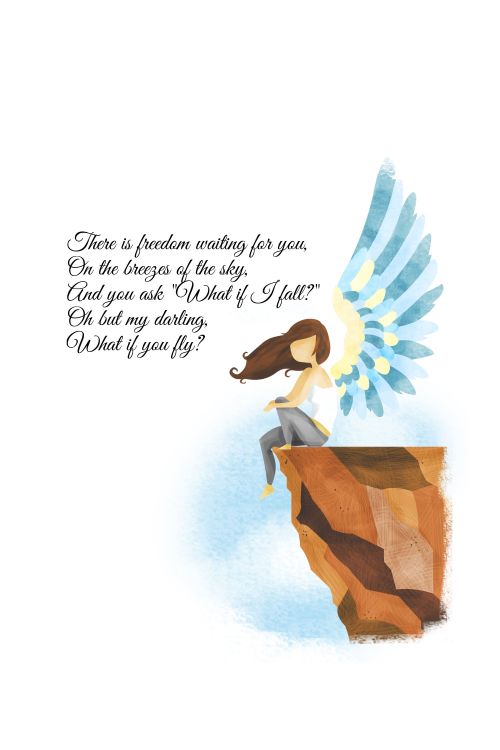
Today I heard someone say what crystallized for me what exactly irks me about the popularization of the meme pictured at right. 

The initials after the quote stand for Erin Hanson, a twenty-year-old Australian who penned these lines while still in her teens:


There is freedom waiting for you,
On the breezes of the sky,
And you ask "What if I fall?"
Oh but my darling,
What if you fly?


On that site, the picture used to illustrate the poem shows a drawing of a girl sitting with her legs dangling over a cliff and a pair of colorful wings on her back. 

The theme is a twist on "nothing ventured, nothing gained." You have to assume some risk to gain the potential benefit of advancing and changing. That's quite true, but I'm still bothered by the way this is set up because we all know what will happen to anyone who tries to jump off a cliff with just a pair of costume wings. 

A life devoid of hope and dreams is pretty gloomy. However, a life based on false hope and irrational expectations is pathetic and sad. So what do you do? You keep your expectations within the realm of possibility and keep the risks within check.

Perhaps that's my own parental bias, but I see it this way. You don't do your children any favors by encouraging them to try things that are not only beyond them but would cause them injury. In other words, you don't tell your kid to go ahead and climb a mountain until s/he has completed training for such a feat. 

What you can do is tell a kid to try to ride a bicycle even if there is a risk of falling and injury (I broke my ankle twice by falling off a bike) because it is a rational expectation that the kid will pick up on the balancing skills and the risk of a broken limb along the way is a manageable one. 

Aspiration is a good thing, but an expectation that one will achieve actual flight is dangeorusly delusional. Before anyone says I'm being too literal, I assure you, I'm very adept at abstract thinking. My point is  not just about defying the laws of physics but about the larger idea of setting up expectations.  

What's attainable, and what's worth the risk? That's something that everyone has to answer for him/herself. Would I venture into woods near dark? No. But I would venture on trails with plenty of hours of sunlight and adequate water. 

From my perspective, venturing out, say to go for an interview, meet friends, or see a new place is worth the risk of hitting traffic or getting somewhat lost, so long as you have a way to get back on track without getting into seriously dangerous areas.  But if I wanted to fly, I'd take a plane. 

Related post: http://kallahmagazine.blogspot.com/2015/03/modeling-behavior-for-child.html


I appreciate your attention and generosity. Tips accepted via Zelle.

If you enjoyed this content, you can support my work with a tip or purchase from my Zazzle store.

If you enjoyed this content, you can support my work with a tip or purchase from my Zazzle store.
Find great gifts and party accessories for literature lovers in all price points.