 |
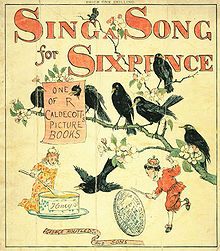
image from https://en.wikipedia.org/wiki/Sing_a_Song_of_Sixpenceg |
What else is the internet for if not to find recipes for such whimsical concoctions dating back over five centuries? I found it on more than one site but went for the one from Chef Frank for better clarify. The origin is an Italian cookbook from 1549 that was translated into English 49 years later. Chef Frank writes up the recipe in modern English with modern instructions, as well as assurances that the birds will be completely unscathed. Supposedly this kind of crust only works with lard, so it wouldn't do for people with kosher or hallal dietary requirements.
Four and Twenty Blackbird Pie
24 live blackbirds12 cups all purpose flour1 1/2 tbsp salt6 eggs, slightly beaten2 lb lard1/2 cup water3 eggs, beaten2-3 heads decorative kale (for garnish)
Make sure all the blackbirds are alive and comfortable. Reserve. In a large bowl, place the flour and salt. Pour the eggs into the center of the bowl and with 2 knives, cut the eggs into the flour until it looks like course cornmeal. In a saucepan, bring the water to a boil and add the lard. Heat until all the lard is melted. Pour hot lard into the flour mixture, and work into a firm dough. While the dough is still warm, divide 2/3 - 1/3. Roll the larger part out on a floured surface into a large circle, at least 36" in diameter. Don't worry if the dough is thick. Keep the other part warm. Find a wide and deep pot big enough to hold 24 standing blackbirds comfortably. Grease the outside of the pot and form the circle of dough around the outside of the pot. This will form the bottom crust, or the "coffin" (no, the birds will still be alive when served! Honest!!). Allow to cool. Cut a circle 6" in diameter in the center of the bottom of the crust (actually, in this case, the top on the form) and remove the dough. Carefully remove the bottom crust from the form and place on parchment paper on a large baking sheet. Crumple sheets of aluminum foil into balls, and place inside the bottom crust, 2" higher in the center than the sides. Roll out the other part of the dough to 2" wider than the coffin. Brush all along the edge of the dough, and place on top of the coffin. Crimp the edges. Using the 6" circle of dough, cut out decoratve shapes. Brush the top crust with the beaten egg and attatch the decorative cut-outs. Don't be bashful - how often do you get to decorate a coffin? Brush again with beaten egg. Place in a 325F oven and bake until the crust is golden brown. Allow to cool.
When the crust has thoroughly cooled, carefully lift up and remove the crumpled foil. Prepare your serving platter by lining it with the decorative kale. You may further dress up your platter with small bunches of grapes, small whole fruit, and/or baby vegetables. When ready to serve, place the coffin on the center of the platter. Gather up your reserved blackbirds. Carefully lift up the coffin and gently place each blackbird inside, being careful not to crowd them. When all the blackbirds have been hidden in the crust, let the crust lie flat on the platter. Serve immediately.
Note that recipes were not written in this fashion centuries back. The original text, which I found here is:
Make the coffin of a great pie or pastry, in the bottome thereof make a hole as big as your fist, or bigger if you will, let the sides of the coffin bee somewhat higher then ordinary pies, which done put it full of flower and bake it, and being baked, open the hole in the bottome, and take out the flower. Then having a pie of the bigness of the hole in the bottome of the coffin aforesaid, you shal put it into the coffin, withall put into the said coffin round about the aforesaid pie as many small live birds as the empty coffin will hold, besides the pie aforesaid. And this is to be done at such time as you send the pie to the table, and set before the guests: where uncovering or cutting up the lid of the great pie, all the birds will flie out, which is to delight and pleasure shew to the company. And because they shall not bee altogether mocked, you shall cut open the small pie, and in this sort you may make many others, the like you may do with a tart. (From Epulario, 1598)
Seems weird to us, of course. But perhaps the people of that time would find things like sprinkles and rainbow bagels even more absurd.


