Monday, September 26, 2016

Isaac Asimov on Creativity

Clearly Isaac Asimov lived before "synergy" (now displaced by "collaboration") was  buzz word. In 2014 MIT Technology Review ran "Isaac Asimov Asks, 'How Do People Get New Ideas?' and cited Asimov's 1959 essay on creativity. 
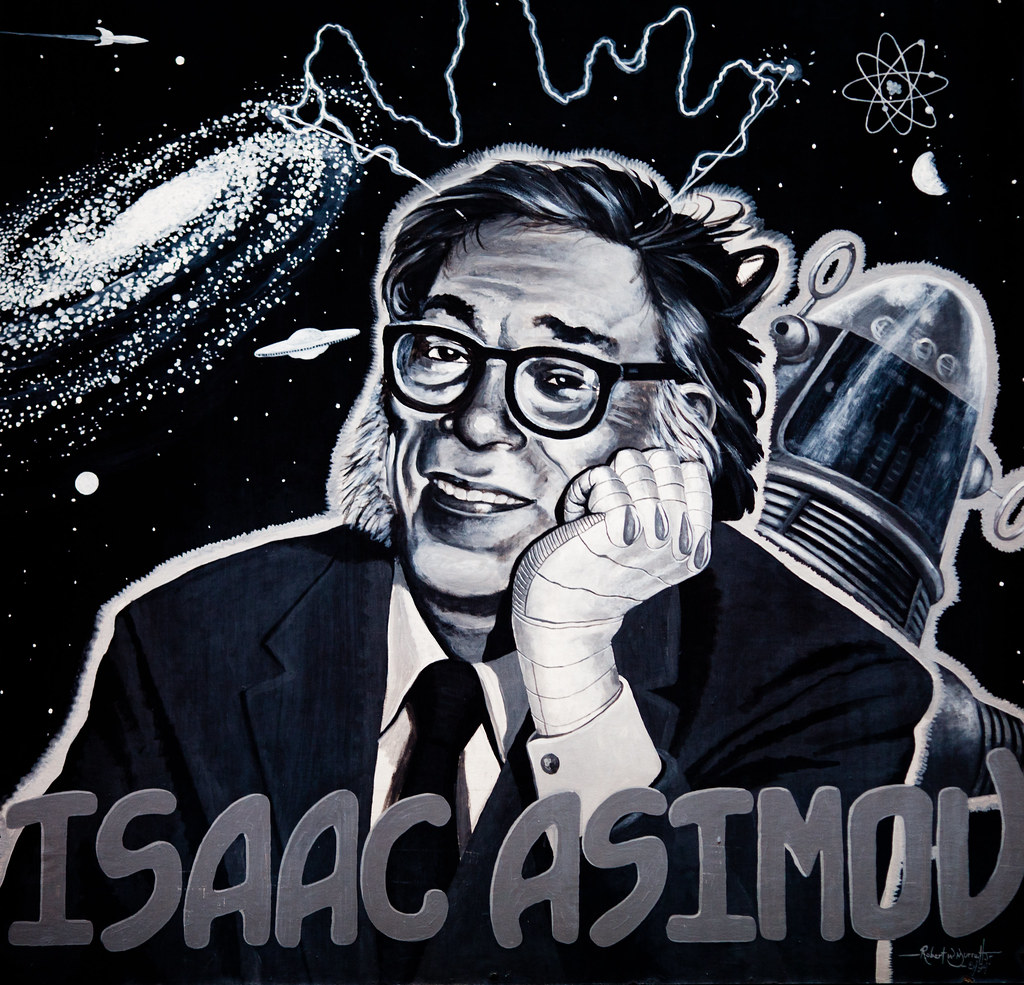
from https://c2.staticflickr.com/8/7380/12625238314_6794bf272c_b.jpg

Like Woz, quoted in Susan Cain's Quiet and here, he does believe "isolation is required" to achieve creativity. His description of a creative mind also corresponds to how introverts operate: "His mind is shuffling his information at all times, even when he is not conscious of it."

What's interesting, though is his describing the intrusion of others as not being a problem due to distraction but to introducing self-consciousness that would impede progress: "For every new good idea you have, there are a hundred, ten thousand foolish ones, which you naturally do not care to display."

However, Asimov doesn't go so far as to say that you should shut yourself off from society altogether. He explains that interacting with others has other benefits for the mind

No two people exactly duplicate each other’s mental stores of items. One person may know A and not B, another may know B and not A, and either knowing A and B, both may get the idea—though not necessarily at once or even soon.
Furthermore, the information may not only be of individual items A and B, but even of combinations such as A-B, which in themselves are not significant. However, if one person mentions the unusual combination of A-B and another the unusual combination A-C, it may well be that the combination A-B-C, which neither has thought of separately, may yield an answer.
Yet that doesn't mean that he considers the group dynamics to lead directly to new creative insights. Instead they "educate the participants in facts and fact-combinations, in theories and vagrant thoughts." For the group to work in that way, he warns that the group has to not be at all censorious. He explains that even one person can poison the atmosphere in which all creative expression is unimpeded:

If a single individual present is unsympathetic to the foolishness that would be bound to go on at such a session, the others would freeze. The unsympathetic individual may be a gold mine of information, but the harm he does will more than compensate for that. It seems necessary to me, then, that all people at a session be willing to sound foolish and listen to others sound foolish.
If a single individual present has a much greater reputation than the others, or is more articulate, or has a distinctly more commanding personality, he may well take over the conference and reduce the rest to little more than passive obedience. The individual may himself be extremely useful, but he might as well be put to work solo, for he is neutralizing the rest.
He also offers advice on capping the number of group members. Any more than five, he believes would be counter productive because of "the tension of waiting to speak, which can be very frustrating." But even more important than that is the question of expectation. In other words, one's official job should not be to what today is called "ideate."

The way he puts it is this: "The great ideas of the ages have come from people who weren’t paid to have great ideas, but were paid to be teachers or patent clerks or petty officials, or were not paid at all." The ideas just came while they pursuing other things, which, he feels is important to remove a sense of obligation: "To feel guilty because one has not earned one’s salary because one has not had a great idea is the surest way, it seems to me, of making it certain that no great idea will come in the next time either."

Sunday, August 28, 2016

Jane Austen and Capability Brown

Hit the road

The 50 miles of good road in Pride and Prejudice, Darcy's 10,000 a year, and the "ha-ha" in Mansfield Park are all features of the times and background for Capability Brown's influence on English gardening.


August 30th 2016 marked the tercentenary of the baptism (his date of birth is unrecorded) of Lancelot 'Capability’ Brown (1716-1783). If you were in England this year, you may have seen certain events dedicated to this man who transformed the British landscape with his vision of naturalistic gardens See The genius of Capability Brown. People in Britain  were  even given the opportunity to buy special stamps to commemorate the 300th anniversary of Capability Brown's birth. 


I only heard about him on this side of the Atlantic because on one of the tours of Old Westbury Gardens  (which were designed to emulate English estates to appeal to the taste of the owner's British bride) the guide mentioned Capability Brown as the designer. Of course, he couldn't have designed the Long Island estate directly, but his influence came through in the play of lawns, trees, and water to be found even on Long Island.

thatched cottage at Old Westbury Gardens


Curious about the person who shares our last name, my husband looked for books about him in our library system. We only succeeded in obtaining one: Roger Turner's  Capability Brown and the Eighteenth-Century English LandscapeThe History Press Rizzoli International Publications, 1985. While Turner frequently quotes the poet Alexander Pope to give some literary background and one time quotes the writer Hannah More, he fails to mention Jane Austen in connection with the transformation of the landscape at all, and this is an omission I intend to rectify here. 


In fact, we owe our visions of Mr. Darcy's beautiful estate, Pemberley, to Capability Brown, as well. He set out the design for Chatsworth House. that house was was used as the setting for Pemberley in the  2005 film adaptation of Pride and Prejudice.

  
In Ch. 32 of Pride and Prejudice, Darcy tells Elizabeth,  "`And what is fifty miles of good road? Little more than half a day's journey. Yes, I call it a very easy distance.''  Darcy was particularly appreciative of "good road"  because it was still a relatively recent convenience that made a dramatic difference to travelers. 

As Turner writes on p. 17, "During Brown's practising years, 1750-80, the time taken between London and the major towns was halved. Before these improvements bad weather and wintry conditions made travel impossible for wheeled traffic."  

Earlier in the book, we have the famous pronouncement about Darcy's wealth amounting to 10,000 a year. That figure is also one that Turner mentions as requisite for an estate owner to really maintain a good figure in society: "At least five or six thousand pounds a year was required to support a great house, to allow for the expenses of the London season and to enable the owner to patronize the arts. More comfortably it required ten thousand a year" (p. 17). 


The book named for a park


Awareness of garden features gains prominence in Austen's Mansfield Park. In chapter 10, Maria Bertram complains: “Yes, certainly, the sun shines, and the park looks very cheerful. But unluckily that iron gate, that ha-ha, give me a feeling of restraint and hardship. ‘I cannot get out,' as the starling said.” Refusing to remain restrained, she goes through, ignoring Fanny's warning of the danger of slipping into the ha-ha.

 Of course, all this foreshadows Maria's breaking through the set boundaries of her marriage and becoming a fallen woman. But there still had to be a physical ha-ha, a type of sunken fence that created a barrier between the extended grounds of the estate where animals could graze and the gardens near the house without obstructing the view. This was not a feature that Brown invented but one that he did use. 


Taylor refers to this device and the explanation for its name on p. 29 in  quotes Horace Walpole's 1770 essay On Modern Gardening: 

"The capital stroke, the leading step to all that has followed, was (I believe the first thought was Bridgeman's) the destruction of walls for boundaries, and the invention of fosses -- an attempt then deemed so astonishing, that the common people called them Ha! Ha!s to express their surprise at finding a sudden and unperceived check to their walk."

In fact, though, Charles Bridgeman (1680?-1738) could not have been the first to make use of this sunken fence, as it already was in use in Versailles before it appeared in England.  However, it appears to have become increasingly common in England in Jane Austen's time, enough so that she could safely assume her readers would be able to picture the obstruction posed by the ha-ha she references several times in Mansfield Park

The woman writer Turner does quote, Hannah  More (p. 78) was already quoted by a prior biographer of the master gardener, Dorothy Stroud. She records what the writer said about here"friend Mr. Brown" who "illustrates everything he says about gardening by some literary or grammatical allusion."

She said:
"He told me he compared his art to literary composition. 'Now there,' pointing a finger, 'I make a comma, and there', pointing to another spot, 'where a more decided turn is proper, I make a colon, at another part, where an interruption is desirable to break the view, a parenthesis, now a full stop, and then I begin another subject.'”

While Taylor doesn't like the literary take on landscaping, it strikes me as an inverse of what Austen said about her own writing in the expression about her own miniature scale. The quote comes from a letter to her nephew, James Edward Austen-Leigh: "What should I do with your strong, manly, vigorous sketches, full of variety and glow? How could I possibly join them on to the little bit (two inches wide) of ivory on which I work with so fine a brush, as produces little effect after much labour?"


Capability Brown's landscaping took a great deal of labor to produce subtle effects that could be appreciated many years later. The same can be said of Austen's novels. 


                                                                                Related posts:
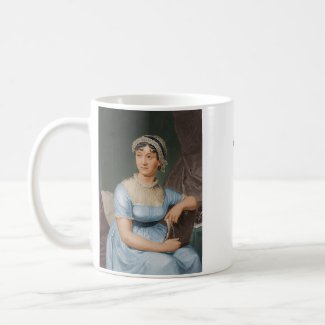
Jane AustenMug Coffee Mug
Jane Austen mug

Jane Austen and Autism
Jane Austen's Heroines
Observations on Jane Austen's Emma
Love and Limerence in Jane Austen
Jane Austen at the Morgan
Three Janes, Two Governesses
Pride and Prejudice in Job Applications

I appreciate your attention and generosity. Tips accepted via Zelle.

If you enjoyed this content, you can support my work with a tip or purchase from my Zazzle store.

If you enjoyed this content, you can support my work with a tip or purchase from my Zazzle store.
Find great gifts and party accessories for literature lovers in all price points.