Monday, February 12, 2018

A Celebration of Rodin

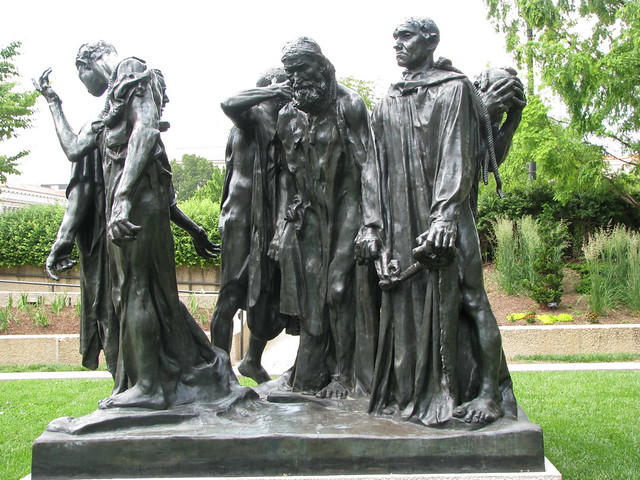
As 2017 marked the 100th anniversary of the death of the most famous sculptor to emerge fromthe  19th Century,  I recently got a double dose of Auguste Rodin. His work was the subject of a special exhibit both at the Met and the Brooklyn Museum. The former closed on the fourth, but the latter is to remain open through April 22.
The Burghers of Calais
https://c2.staticflickr.com/4/3279/2866409509_c5b7bdff7d_z.jpg?zz=1


It's worth seeing, not because you can't see these Rodin pieces in other exhibits but because of some of the insight it offers. For example, there's a video that shows the process currently used for casting in bronze that still uses lost wax as it did in Rodin's day, though it also incorporates some modern materials that would not have been been accessible to him.

But the one part of the exhibit that made the biggest impression on me was the account of Rodin's early art education. When he was 14, he began his formal art eduction at  the École Impériale Spéciale de Dessin et de Mathématiques – known as the “Petite École," to distinguish it from the   the top school, the École des Beaux-Arts. Rodin applied to that school at 17 and was rejected -- not just once but three times.

It's an amazing thing when you think about: the biggest name in sculpture in his day was seen as unworthy of the best art school. It's possible to infer a great many things from this about the limits of expert knowledge in terms of predicting success, self-awareness of talent that rises above the assessment of others, or even the possibility the true achievement is not a matter of what one is taught but what one learns to do on his own.


Sunday, December 3, 2017

Once in a Blue Moon

Super Moon image from https://commons.wikimedia.org/wiki/File:Supermoon.jpg


Tonight we will have a Super Moon, as we will next month and the month after that. But the third one is special because it  will also be lined up for a lunar eclipseBut wait, that's not all that's special about the January 31, 2018 full moon. It falls under the designation of a Blue Moon -- at least in one sense. 

"Once in a blue moon." How often is that? about every 2 1/2 years, though whether you'd say 2.5 or 2.7  depends on which definition you use for blue moon, .

From the time I looked it up some years ago, I considered the blue moon to refer to the second full moon in a solar calendar month. (Obviously, lunar calendars are designed to have only a single full moon in a month). However, today I looked it up and found that it also had another meaning that is a bit more precise, though not as commonly used today.

The older meaning defines a Blue Moon as the third full moon in a season that has four full moons. Called a seasonal Blue Moon, this occurs about every 2.5 years, according to NASA. Why the third moon? There are roughly 29.5 days between full moons, making it unusual for two full moons to fit into a 30- or 31-day-long month. 
Accordingly, what fits a blue moon definition in one sense may not fit it another. The seasonal blue moon last occurred on May 21, 2016. But a blue moon measured by month rather than by season can only occur at the very end of the month, and that is said to occur about every 2.7 years.

Here's the infographic from: https://www.space.com/16776-blue-moon-explained-infographic.html

This particular terms has evolved into multiple meanings that deviate quite a bit from the strictly astronomical.  Space.com link brought me to : http://www.skyandtelescope.com/observing/once-in-a-blue-moon/, which traces the terms through various meanings, including some specific to songs. The earliest it finds is an expression of absurdity that then came to mean never:


like saying the Moon is made of green cheese. Both were obvious absurdities, about which there could be no doubt. "He would argue the Moon was blue" was taken by the average person of the 16th century as we take "He'd argue that black is white."
 The concept that a blue Moon was absurd (the first meaning) led eventually to a second meaning, that of "never." The statement "I'll marry you, m'lady, when the Moon is blue!" would not have been taken as a betrothal in the 18th century.
 Then there were times when the moon actually appeared blue, as a result of huge amounts of ash in the air from volcanoes or fires.
So, by the mid-19th century, it was clear that visibly blue Moons, though rare, did happen from time to time — whence the phrase "once in a blue Moon." It meant then exactly what it means today, a fairly infrequent event, not quite regular enough to pinpoint. That's meaning number four, and today it is still the main one.
However, from an astronomical point of view, the blue moon did come to mean something more specific, though the way we tend to use it today -- the definition I taught my own kids -- seems to find its roots only as far back as the 20th Century. 

One striking fact for those of us who are familiar with lunar calendars is how the frequency of blue moons dovetails with leap months, namely 7 times in every 19 year cycle. The Chinese calendar adds a leap month about once every 3 years, and the the Jewish calendar is set to haves 7 leaps years every 19 years.   

I appreciate your attention and generosity. Tips accepted via Zelle.

If you enjoyed this content, you can support my work with a tip or purchase from my Zazzle store.

If you enjoyed this content, you can support my work with a tip or purchase from my Zazzle store.
Find great gifts and party accessories for literature lovers in all price points.