 While reading Nathalia's Holt's The Queens of Animation: The Untold Story of the Women Who Transformed the World of Disney and Made Cinematic History I learned a number of surprising things about the development of Disney's films - both the most iconic and the ones that do not survive on video because of their overt racism (ike Songs of the South) or the ones that have been censored for the same reason (like Fantasia).
But for me the most surprising revelation of the book was about a Disney movie I've never even seen. Before Bambi made it to film, it was a novel written by Felix Salten and called Bambi: A Life in the Woods.
The author was born in Budapest in 1869, though his family moved when he was a month old to Vienna. The motive, as Holt explains (96) was to gain greater opportunity in a city that had begun granting some rights to Jewish resident in 1867.
Salten had a strong sense of Jewish identity that found expression in his passion for Zionism. Like the fictional Mordechai in George Eliot's Daniel Deronda, he was a big advocate for a Jewish homeland.
Salten's novel first saw print in the form of newspaper serialization in Vienna in 1923.
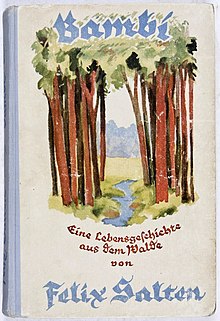
While this is a revelation for people familiar with the deer as depicted by Disney animation, back in the early 20th Century, people understood the allegory. Even the description of the butterflies touches on the experience of people who cannot find any permanent home "'always searching further and further because all the good places have already been taken,'" Holt quotes (26).
Bambi was a means of exploring the themes related to Jewish identity and surivial. The deer in this story are not carefree creatures but burdened by the persecution they endure from hunters and who have to consider if assimilation is the path to take to survive.
While some animals adopt "If you can't lick 'em, join 'em" to try to survive with hunters, that strategy fails them, as illustrated by a character who believes wearing a halter will protect him who ends up shot by a hunter. Likewise, the dogs in the novel are described by Bambi's father thus: "'They pass their lives in fear, they hate [Man] and themselves and yet die for His sake'" (quoted in Holt 96).
Though Holt comments on how very appropriate that was for the time at which Bambi is made, it really is a perennial theme for people who have repeatedly been displaced and threatened.
The book is interesting also for the glimpses into working as a woman in what was very much a man's field, and the bad old days of sexism, racism, and persecution of Asians under Roosevelt. If aviation is also of interest, you may enjoy her tangents about the animators who also aspired to fly and their achievements in the air as well as on film.

