What does it take for a post to go viral? Something that impresses people for its originality and relatability. Mammoth Cave National Park pulled that off by veering off the well-worn path of describing attractions like that.
While this is more marketing-centered than what I usually post on this blog, the theme of uncommon content made me decide to place it her rather than on my WriteWayPro blog.
This post is not about knocking generative AI. As I said in An Apology to Generative AI , the hackneyed that we see in ChatGPT output originated with humans who parrot each other instead of aspiring to fresher expressions. Ask generative AI to write up a paragraph meant to encourage people to visit Mammoth Cave National Park and you get nearly interchangeable results:
From Google Gemini
Descend into the depths of history at Mammoth Cave National Park. With over 400 miles of mapped passages, this underground wonderland is the longest known cave system in the world. Explore ancient formations, marvel at the beauty of nature's hidden wonders, and experience the thrill of adventure. Whether you're a seasoned explorer or a curious novice, Mammoth Cave offers unforgettable experiences for all ages.
From ChatGPT
Discover the hidden wonders beneath the surface at Mammoth Cave National Park, where adventure and natural beauty converge in a breathtaking underground labyrinth. With the world's longest known cave system stretching over 400 miles, this UNESCO World Heritage site offers an array of guided tours showcasing stunning stalactites, stalagmites, and ancient cave formations. Beyond the caves, the park's diverse landscapes beckon with lush forests, scenic trails, and tranquil rivers perfect for hiking, kayaking, and wildlife spotting. Whether you're a thrill-seeker eager to explore deep caverns or a nature lover seeking serene outdoor experiences, Mammoth Cave National Park promises an unforgettable escape into one of America's most remarkable natural wonders.
From Claude
Discover the awe-inspiring wonders of Mammoth Cave National Park, home to the world's longest known cave system. Explore over 400 miles of surveyed passageways, from vast chambers to narrow tunnels, each telling a unique geological story. Above ground, hike through lush forests, paddle scenic rivers, and spot diverse wildlife. Whether you're an adventure seeker, nature lover, or history buff, Mammoth Cave offers unforgettable experiences for all ages. Come uncover the hidden treasures beneath Kentucky's rolling hills and create memories that will last a lifetime.
The social media content manager for this particular park decided to take a completely different approach. Likely this text was informed by the common experience of visiting a place that is touted as awesome and find that it just doesn't live up to the hype. This breath-of-fresh-air honesty proved so memorable that over 100K liked it, over 9K commented, nad 30K shared the post, giving it an impressive amount of reach at no cost.
Here's the text: Come experience what has disappointed millions of people for over 225 years! Mammoth Cave National Park recently rated as one of the “most disappointing U.S. tourist attractions”! While we think the world’s longest cave system and over 4,000 years of human history is AMAZING, others find that the cave is “very dark” and there is “nothing cool” here to see. If you would like to experience the disappointment of Mammoth Cave, visit our website and choose from one of our many activities that will leave you unfulfilled! You can be disappointed by a “dry hole with very few stalagmites and stalactites” or discover nothing “other than trees” on over 80+ miles of hiking, biking, horseback riding, and water trails. (Fair warning – there are bugs in the outdoors, cellular phone service is spotty, and there are stairs on some of our cave tours.) A world of regret awaits you at Mammoth Cave!
Make your cave tour reservations and find all the information you need to plan your very own “not enjoyable” visit to Mammoth Cave National Park at: https://ow.ly/8ifx50T59Eo
I've been disappointed in the place since I was 6. 61 years of being let down (pun fully intended). I don't know why I keep coming back. I'm mean, it just takes forever for anything to change in that hole.
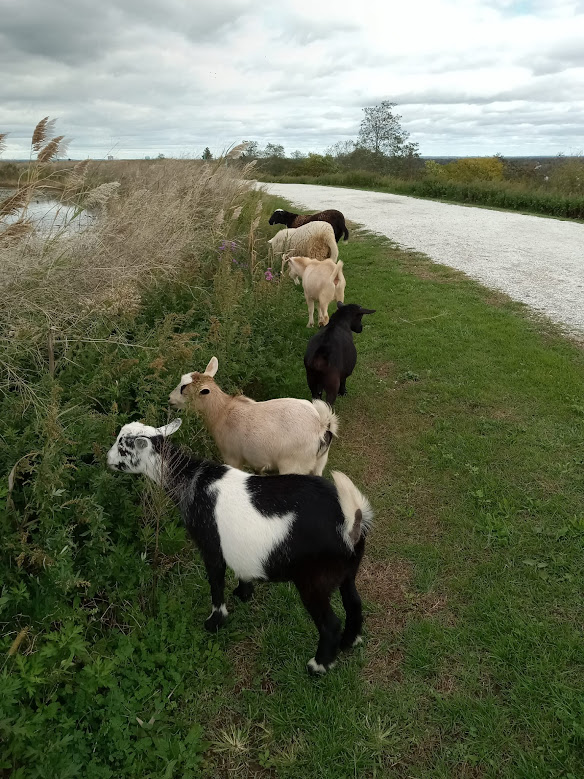
Goats munching on weeds in Norman Levy Park: Photo by Ariella Brown
The sight of carpet-like, green lawn may be priceless, but what goes into preparing it is a multi-billion dollar market. In 2023, The global lawn mowers market was valued at a whopping $32.31 billion.
Most of those sales don't come from your basic manual style that relies on the rotary blade turned when you push it. While that style of lawn mower doesn’t take a toll on the environment, most people –and the gardeners that they employ – use machines powered by gas or electricity.
While those machines have evolved to now feature advanced technology like GPS and even claims of AI, there is a simultaneous movement to embrace the very low tech approach to grass cutting that predates the invention of the lawn mower in 1830.
Let’s take a brief tour of mowing grass from the 1700s to the present.
Parklands in the 1700s
When you picture a park, something like Central Park may spring to mind. Today’s parks are public spaces that offer a respite of green lawns and trees, especially in urban areas.
But back in the days of large country estates, a park could, in fact, be the private property of one wealthy family.
That’s certainly the case of Mansfield Park, the estate that was featured as the title for one of Jane Austen’s novels.Mansfield Park was written some time after Lacelot Capability Brown had reshaped the English landscape with rolling lawn and naturally set trees, shrubs, and bodies of water. His landscape designs offered a softer, less artificial effect to gardens than the formal garden styles that had been popularized by the very wealthy on the Continent.
Those acres of grass needed to be trimmed regularly. One way was with grazing animals, typically sheep, who would also furnish the estate with wool, or possibly even cows that would provide milk. This required no more work than bringing the animals out to do what they do naturally, and they also provided the fertilizer in the same manner.
Another way that grass was kept in shape was through very arduous human labor. This is something that only the really wealthy could afford, hiring a team of gardeners merely to beautify their land with no yield of produce resulting from the work.
A manicured lawn was a very visible sign of wealth and status. This is what is depicted in Leo Tolstoy’s novel Anna Karenina.
If you’ve read the book or seen it rendered into film, you may have been struck by the sheer physical labor involved in mowing. As you can see in the clip below, it took a small army of men armed with scythes many hours to cut the grass neatly.
it would seem that the lawn mower had not made its way over to Tolstoy's part of Russia by 1873 -- when his book was release in installments. But a machine to reduce the amount of exertion necessary to trim grass had already been invented in England over forty years before that.
The first lawn mower
Edwin Beard Budding, an engineer from Stroud, Gloucestershire, England invented the lawn mower in 1830. He is said to have taken the concept of its operation from the operation of a machine in a cloth mill that employed a cutting cylinder (or bladed reel) to trim the surface of woolen cloth and leave it with a smooth finish.
According to the post on “Mower History,” published by The Old Lawnmower Club, Budd partnered with another engineer named John Ferrabee to produce his mower design in a factory. A number of museums in the UK showcase such machines, and you can see a photo of one here.
Budding’s invention was actually not quite the design we use today, though it certainly paved the way. The lawn mower went through a number of improvements through other English inventors.
One of them was the Silens Messor, which was introduced by Thomas Green and Sons of Leeds and London in 1859. Using a chain to transfer power from the roller in the back to the cutting cylinder made it both more reliable and quieter to operate, hence the name, which means silent operation in Latin.
The first American patent for a lawn mower was awarded 1868 to Amariah Hills of Connecticut. It employed a reel-type spiral-bladed cutter” Two years later, Elwood McGuire came up with a “lighter, simpler machine” that was very popular. But there was yet another innovation at the very end of the century.
The improved lawn mower is an African-American invention
On Sept. 8, 1898, John Albert Burr applied for a patent for his lawn mower design. He was granted U.S. patent 624,749 on May 9, 1899. The application describes the uniqueness of his invention as follows:
This invention relates to improvements in lawn-mowers of the most common type, comprising traction-wheels and a rotary cutter or shear operating in conjunction with a fixed bar relative to which the curved knife of the rotary cutter has shearing actions.
Why lawn mowers became so popular
Burr enjoyed quite a bit of success from his invention because it emerged at a time when gardening was taking off for the middle class. That’s what is posited in the American Gardening blog post entitled, “Victorian Middle Class Wanted the Lawn Mower.”
While English gardens may have set the expectation for lawns on middle class homes, it also took root in American soil, thanks to the influence of prominent landscapers like Frederick Law Olmsted (1822-1903).He is the one who set out the vision for New York City’s Central Park in 1858 to include a Sheep Meadow.
Sheep did in fact graze there, trimming and fertilizing the grass the old-fashioned way between 1864 and 1934. They were considered to add a “Romantic English quality” to the landscape.
But for people who sought to emulate the look of neat grass without having to keep farm animals, there had to be another option beyond the heavy investment in labor with a scythe and so the lawn mower became a necessity for the fashionable home adorned by a lawn.
The Victorian Middle Class Wanted the Lawn Mower blog shows an ad for the Buckeye Lawn Mower from Springfield, Massachusetts from some time in the 1890s. It shows a fashionably dressed woman accompanied by an equally fashionably dressed girl who is pushing a lawn mower.Here mowing is depicted as a genteel, ladylike act of gardening, a far cry from the sweat-inducing labor we saw in Anna Karenina.
Fueling lawn mowers and pollution
Mowing actually did become a lot more effortless thanks to motorization. Te Old Lawnmower Club dates “lightweight petrol [what we call gas in the U.S.] engines and small steam power units: all the way back to the 1890s.
Over in the United States, gas-powered mowers were first manufactured in 1919 by Colonel Edwin George. But it was too costly for homeowners until after World War II.
Affordable gas-powered mowers, no doubt, promoted a lot of green lawns to adorn the houses sprouting up in new suburban neighborhoods after the war. The design of tractor-like models that didn’t need to be pushed but driven to cover large areas quickly and easily were particularly appealing to those who had large areas to mow..
In1948 Max Swisher of Missouri invented an innovative zero-turn mower called the “Ride King..” As the name indicates the wheel could be turned 180 degrees, which eliminated the need to turn the whole thing around when tackling a new row. .
How green was my lawnmower?
Advances like these made mowing more efficient, though the green effect is not all that green in terms of energy consumption.
The stats on the resources expended to keep up green lawns in the United States are rather alarming. “Lawns use about 800 million gallons of gasoline a year to harvest their ‘crop’ of grass with lawnmowers, about 1/4 of 1% of national petroleum use,” according to Reducing Water for Lawns.
Regulations on emissions for lawn mowers only approached the stringency of those applied to cars in 2008, As a result, they are now cleaner than they had been, though how clean depends on what you choose.
What about electric power?
Electric lawn mowers have been around for decades, but they were generally not as popular as gas-powered ones in part because they were tethered to a cord. However, this is changing with new designs. I bought one myself a few years ago from Worx. It came with rechargeable batteries. A single charge powers up all the mowing of the front and back lawn.
Remote control lawn mowers started emerging around the beginning of our current century. But in the past year or two, you’d more likely see them rebranded as “AI-powered.” One of the companies benign them calls the line Electric Sheep. The name is a perfect segue to the sheep and goat used in the past that have made a comeback as an environmentally sound solution for trimming grass and weeds.
Putting the Goat back in Gotham
Goats can reach where people and most machines cannot, and what is work for people is just grazing for them.Accordingly, On May 21, 2019 Riverside Park Conservancy launched what it callsGoathem. It introduced goats to trim back the invasive plants in hard-to-reach section of the park.
As “goats are naturally effective weed whackers,” the park explains, “putting them to work in Goatham is like treating them to an all-you-can-eat buffet.” They can even eat poison ivy with no ill effects.
While the New York City park may not admit it, the inspiration for its use of goats may have come from the Norman J. Levy Park and Preserve in Merrick. The goats pictures above are from there.
The original group of Nigerian dwarf goats joined the park the early years of the current century and have since multiplied over the generations. They’ve also been augmented by 5 new goats and 2 new sheep that joined in May 2023. They all contribute to clearing the grounds and maintaining the environment in this park.
So we’ve come full circle in recognizing what animals can contribute as natural lawn mower even while packing even more bells and whistles in the machine designed for the job back in 1830.
If you have a lawn, how do you deal with maintaining it?

'/%3E%3Cpath d='M16.0001 7.9996c0 4.418-3.5815 7.9996-7.9995 7.9996S.001 12.4176.001 7.9996 3.5825 0 8.0006 0C12.4186 0 16 3.5815 16 7.9996Z' fill='url(%23paint1_radial_15251_63610)'/%3E%3Cpath d='M16.0001 7.9996c0 4.418-3.5815 7.9996-7.9995 7.9996S.001 12.4176.001 7.9996 3.5825 0 8.0006 0C12.4186 0 16 3.5815 16 7.9996Z' fill='url(%23paint2_radial_15251_63610)' fill-opacity='.5'/%3E%3Cpath d='M7.3014 3.8662a.6974.6974 0 0 1 .6974-.6977c.6742 0 1.2207.5465 1.2207 1.2206v1.7464a.101.101 0 0 0 .101.101h1.7953c.992 0 1.7232.9273 1.4917 1.892l-.4572 1.9047a2.301 2.301 0 0 1-2.2374 1.764H6.9185a.5752.5752 0 0 1-.5752-.5752V7.7384c0-.4168.097-.8278.2834-1.2005l.2856-.5712a3.6878 3.6878 0 0 0 .3893-1.6509l-.0002-.4496ZM4.367 7a.767.767 0 0 0-.7669.767v3.2598a.767.767 0 0 0 .767.767h.767a.3835.3835 0 0 0 .3835-.3835V7.3835A.3835.3835 0 0 0 5.134 7h-.767Z' fill='%23fff'/%3E%3Cdefs%3E%3CradialGradient id='paint1_radial_15251_63610' cx='0' cy='0' r='1' gradientUnits='userSpaceOnUse' gradientTransform='rotate(90 .0005 8) scale(7.99958)'%3E%3Cstop offset='.5618' stop-color='%230866FF' stop-opacity='0'/%3E%3Cstop offset='1' stop-color='%230866FF' stop-opacity='.1'/%3E%3C/radialGradient%3E%3CradialGradient id='paint2_radial_15251_63610' cx='0' cy='0' r='1' gradientUnits='userSpaceOnUse' gradientTransform='rotate(45 -4.5257 10.9237) scale(10.1818)'%3E%3Cstop offset='.3143' stop-color='%2302ADFC'/%3E%3Cstop offset='1' stop-color='%2302ADFC' stop-opacity='0'/%3E%3C/radialGradient%3E%3ClinearGradient id='paint0_linear_15251_63610' x1='2.3989' y1='2.3999' x2='13.5983' y2='13.5993' gradientUnits='userSpaceOnUse'%3E%3Cstop stop-color='%2302ADFC'/%3E%3Cstop offset='.5' stop-color='%230866FF'/%3E%3Cstop offset='1' stop-color='%232B7EFF'/%3E%3C/linearGradient%3E%3C/defs%3E%3C/svg%3E)
'%3E%3Cpath d='M15.9953 7.9996c0 4.418-3.5816 7.9996-7.9996 7.9996S-.004 12.4176-.004 7.9996 3.5776 0 7.9957 0c4.418 0 7.9996 3.5815 7.9996 7.9996Z' fill='url(%23paint0_linear_15251_63610)'/%3E%3Cpath d='M15.9973 7.9992c0 4.4178-3.5811 7.9992-7.9987 7.9992C3.5811 15.9984 0 12.417 0 7.9992S3.5811 0 7.9986 0c4.4176 0 7.9987 3.5814 7.9987 7.9992Z' fill='url(%23paint1_radial_15251_63610)'/%3E%3Cpath d='M15.9953 7.9996c0 4.418-3.5816 7.9996-7.9996 7.9996S-.004 12.4176-.004 7.9996 3.5776 0 7.9957 0c4.418 0 7.9996 3.5815 7.9996 7.9996Z' fill='url(%23paint2_radial_15251_63610)' fill-opacity='.8'/%3E%3Cpath d='M12.5278 8.1957c.4057.1104.6772.4854.623.9024-.3379 2.6001-2.5167 4.9012-5.1542 4.9012s-4.8163-2.3011-5.1542-4.9012c-.0542-.417.2173-.792.623-.9024.8708-.237 2.5215-.596 4.5312-.596 2.0098 0 3.6605.359 4.5312.596Z' fill='%234B280E'/%3E%3Cpath d='M11.5809 12.3764c-.9328.9843-2.1948 1.6228-3.5841 1.6228-1.3892 0-2.6512-.6383-3.5839-1.6225a1.5425 1.5425 0 0 0-.016-.0174c.4475-1.0137 2.2-1.3599 3.5999-1.3599 1.4 0 3.1514.3468 3.5998 1.3599l-.0157.0171Z' fill='url(%23paint3_linear_15251_63610)'/%3E%3Cpath fill-rule='evenodd' clip-rule='evenodd' d='M13.3049 5.8793c.1614-1.1485-.6387-2.2103-1.7872-2.3717l-.0979-.0138c-1.1484-.1614-2.2103.6388-2.3717 1.7872l-.0163.1164a.5.5 0 0 0 .9902.1392l.0163-.1164c.0846-.6016.6408-1.0207 1.2424-.9362l.0978.0138c.6016.0845 1.0207.6407.9362 1.2423l-.0164.1164a.5.5 0 0 0 .9903.1392l.0163-.1164ZM2.6902 5.8793c-.1614-1.1485.6387-2.2103 1.7872-2.3717l.0979-.0138c1.1484-.1614 2.2103.6388 2.3717 1.7872l.0164.1164a.5.5 0 1 1-.9903.1392l-.0163-.1164c-.0846-.6016-.6408-1.0207-1.2423-.9362l-.098.0138c-.6015.0845-1.0206.6407-.936 1.2423l.0163.1164a.5.5 0 0 1-.9902.1392l-.0164-.1164Z' fill='%231C1C1D'/%3E%3C/g%3E%3Cdefs%3E%3CradialGradient id='paint1_radial_15251_63610' cx='0' cy='0' r='1' gradientUnits='userSpaceOnUse' gradientTransform='matrix(0 7.9992 -7.99863 0 7.9986 7.9992)'%3E%3Cstop offset='.5637' stop-color='%23FF5758' stop-opacity='0'/%3E%3Cstop offset='1' stop-color='%23FF5758' stop-opacity='.1'/%3E%3C/radialGradient%3E%3CradialGradient id='paint2_radial_15251_63610' cx='0' cy='0' r='1' gradientUnits='userSpaceOnUse' gradientTransform='rotate(45 -4.5272 10.9202) scale(10.1818)'%3E%3Cstop stop-color='%23FFF287'/%3E%3Cstop offset='1' stop-color='%23FFF287' stop-opacity='0'/%3E%3C/radialGradient%3E%3ClinearGradient id='paint0_linear_15251_63610' x1='2.396' y1='2.3999' x2='13.5954' y2='13.5993' gradientUnits='userSpaceOnUse'%3E%3Cstop stop-color='%23FFF287'/%3E%3Cstop offset='1' stop-color='%23F68628'/%3E%3C/linearGradient%3E%3ClinearGradient id='paint3_linear_15251_63610' x1='5.1979' y1='10.7996' x2='5.245' y2='14.2452' gradientUnits='userSpaceOnUse'%3E%3Cstop stop-color='%23FF60A4'/%3E%3Cstop offset='.2417' stop-color='%23FA2E3E'/%3E%3Cstop offset='1' stop-color='%23BC0A26'/%3E%3C/linearGradient%3E%3CclipPath id='clip0_15251_63610'%3E%3Cpath fill='%23fff' d='M-.002 0h16v15.9992h-16z'/%3E%3C/clipPath%3E%3C/defs%3E%3C/svg%3E)


'%3E%3Cpath d='M15.9963 8c0 4.4179-3.5811 7.9993-7.9986 7.9993-4.4176 0-7.9987-3.5814-7.9987-7.9992 0-4.4179 3.5811-7.9992 7.9987-7.9992 4.4175 0 7.9986 3.5813 7.9986 7.9992Z' fill='url(%23paint0_linear_15251_63610)'/%3E%3Cpath d='M15.9973 7.9992c0 4.4178-3.5811 7.9992-7.9987 7.9992C3.5811 15.9984 0 12.417 0 7.9992S3.5811 0 7.9986 0c4.4176 0 7.9987 3.5814 7.9987 7.9992Z' fill='url(%23paint1_radial_15251_63610)'/%3E%3Cpath d='M7.9996 5.9081c-.3528-.8845-1.1936-1.507-2.1748-1.507-1.4323 0-2.4254 1.328-2.4254 2.6797 0 2.2718 2.3938 4.0094 4.0816 5.1589.3168.2157.7205.2157 1.0373 0 1.6878-1.1495 4.0815-2.8871 4.0815-5.159 0-1.3517-.993-2.6796-2.4254-2.6796-.9811 0-1.822.6225-2.1748 1.507Z' fill='%23fff'/%3E%3C/g%3E%3Cdefs%3E%3CradialGradient id='paint1_radial_15251_63610' cx='0' cy='0' r='1' gradientUnits='userSpaceOnUse' gradientTransform='matrix(0 7.9992 -7.99863 0 7.9986 7.9992)'%3E%3Cstop offset='.5637' stop-color='%23E11731' stop-opacity='0'/%3E%3Cstop offset='1' stop-color='%23E11731' stop-opacity='.1'/%3E%3C/radialGradient%3E%3ClinearGradient id='paint0_linear_15251_63610' x1='2.3986' y1='2.4007' x2='13.5975' y2='13.5993' gradientUnits='userSpaceOnUse'%3E%3Cstop stop-color='%23FF74AE'/%3E%3Cstop offset='.5001' stop-color='%23FA2E3E'/%3E%3Cstop offset='1' stop-color='%23FF5758'/%3E%3C/linearGradient%3E%3CclipPath id='clip0_15251_63610'%3E%3Cpath fill='%23fff' d='M-.001.0009h15.9992v15.9984H-.001z'/%3E%3C/clipPath%3E%3C/defs%3E%3C/svg%3E)